facebook
favorite button
super instructor icon
Trusted teacher
This teacher has a fast response time and rate, demonstrating a high quality of service to their students.
member since icon
Since November 2021
Instructor since November 2021
Programming and Hardware Designing of Microcontroller 8051
course price icon
From 40 C$ /h
arrow icon
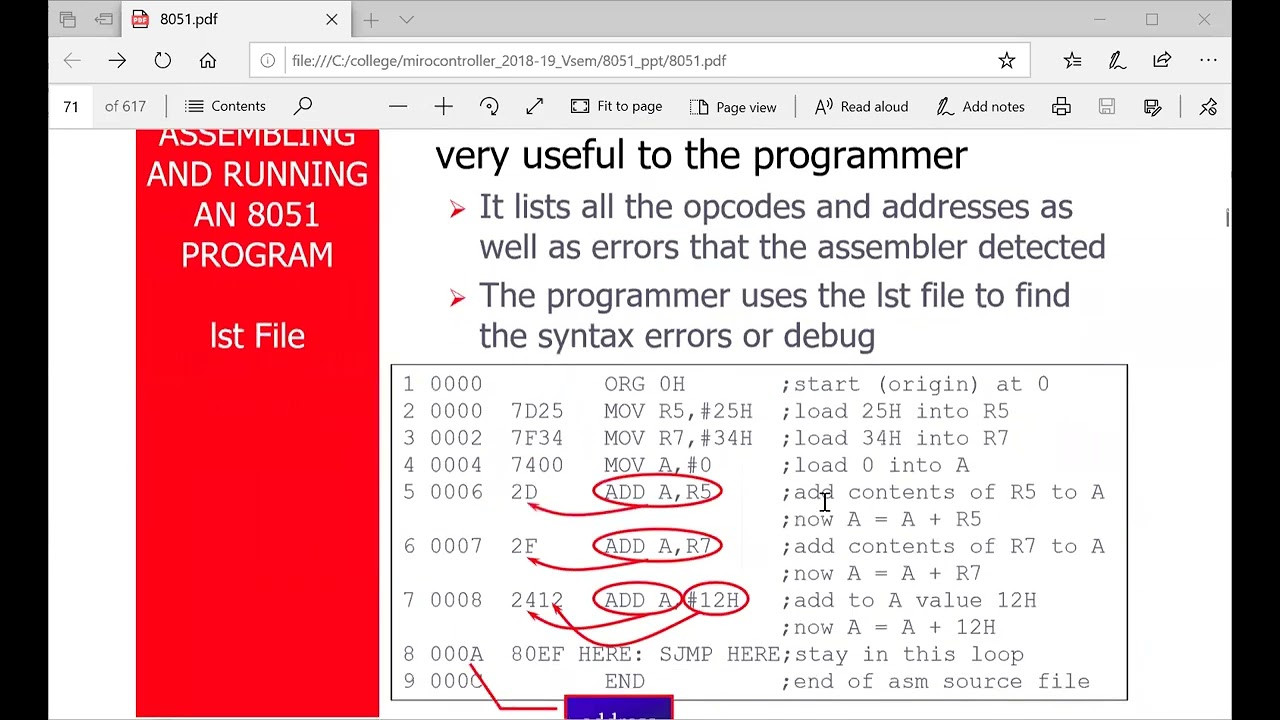
Programming the 8051 Microcontroller.
In this course you can be able understand the history and how a microcontroller is organized inside the internal structurer. The principle in the digital computing and the way of stored programmed concept. We will spend few hours on the basics of digital computing and will understand the hardware architecture of microcontroller 8051. The assembly language programming of 8051. The Programming on the 8051 resources along with the complier activity. We will learn to use the keil compilers and do the software simulation both in assembly and C. We will understand how to dump the hex file to the microcontroller. The detailed way of organizing and designing the memory map for 8051 will be studied with address map calculation. will design sample boards. Finally will design the 8051 based boards of Analog signal acquisition to microcontroller 8051 and delivering to a Digital to analog converter for Realtime signal functionality.
Extra information
Laptop with good internet
Location
location type icon
Online from India
About Me
Many of the Micro-controller and Microprocessor teachers teaches the course more on the theory and book contents. The deviation in this learning part is the students are not knowing the internal bit level functioning inside the CPU and the tricks in the assembly level programming. In this place where i can able to clarify more to the students on the bit level function of different levels of processor domain classes. Interfacing sensor and actuators with controllers and memory interface area are the strong area of my teaching in which students can definitely understand and able to design any type of processor system. Memory mapping is an another area where distinct design making with more number of device will be demonstrated and make the students to practice with good design. I can help them in the processor assignments and tutorial solving. ARM processor theory can be introduced to students and simple program execution can be demonstrated. The theoretical knowledge of RTOS will be demonstrated in a more understandable way to the students. Generally I teach the subjects. I can't write exams for the students.
Arduino is an another easier hardware in which we can interface many sensors and take the analog signals and do some processing the send the processed signal to the output actuator. Many sensors i have interfaced to Arduino and triggered many actuator. I ca n help students in making projects based on Arduino boards.
Education
Ph.D. (Instrumentation and Control Engineering)
2011, National Institute of Technology, Tiruchirappalli
M.E. (Electronics and Communication Engineering)
2000, National Institute of Technical Teachers Training Institute, Chandigarh
B.E. (Electronics and Communication Engineering)
1988, Mohamed Sathak Engineering College, Keelakarai (Madurai Kamaraj University)
Experience / Qualifications
2020 to Till date Technology reviewer Cannytech Solutions, Texas , US
2013-2020 Associate Professor Thiagarajar college of engineering, Madurai
2010-2013 Assistant Professor Thiagarajar college of engineering, Madurai
2006-2010 Senior Lecturer Thiagarajar college of engineering, Madurai
2001-2006 Lecturer Thiagarajar college of engineering, Madurai
1991-2001 Lecturer SLIET, Longowal, Punjab, Govt. of India
Age
Children (7-12 years old)
Teenagers (13-17 years old)
Adults (18-64 years old)
Seniors (65+ years old)
Student level
Beginner
Intermediate
Advanced
Duration
60 minutes
The class is taught in
English
Availability of a typical week
(GMT -04:00)
New York
at teacher icon
Online via webcam
Mon
Tue
Wed
Thu
Fri
Sat
Sun
00-04
04-08
08-12
12-16
16-20
20-24
Many of the Micro-controller and Microprocessor teachers teaches the course more on the theory and book contents. The deviation in this learning part is the students are not knowing the internal bit level functioning inside the CPU and the tricks in the assembly level programming. In this place where I can able to clarify more to the students on the bit level function of different levels of processor domain classes. Interfacing sensor and actuators with controllers and memory interface area are the strong area of my teaching in which students can definitely understand and able to design any type of processor system. Memory mapping is an another area where distinct design making with more number of device will be demonstrated and make the students to practice with good design. I can help learners in practicing the microprocessor assignments and tutorial solving. ARM processor theory can be introduced to students and simple program execution can be demonstrated. The theoretical knowledge of RTOS will be demonstrated in a more understandable way to the students. Generally I teach the subjects. I can't write exams for the students.
Arduino is an another easier hardware in which we can interface many sensors and take the analog signals and do some processing and send the processed signal to the input of a actuator. Practically different sensors I have interfaced to Arduino and triggered many actuator. I can help students in making projects based on Arduino boards.
Read more
Similar classes
arrow icon previousarrow icon next
verified badge
I offer teaching courses in electrical engineering and electronics (private lessons or holiday courses) to deal with the difficulties encountered by students during their schooling, as part of an individual follow-up that respects the rhythm specific to each.
These courses allow the student to get back to level and regain confidence in all scientific subjects, as well as effectively preparing him for the Baccalaureate, Preparatory Classes or various exams.

COURSE OBJECTIVES AND PEDAGOGICAL APPROACH

Resumption and deepening of fundamental concepts through exercises with course reminders.

Put the student in a situation of questioning and research.

Respond to individual issues and questions

Exercise training in order to achieve real mastery of the content.

Learn to build theoretical reasoning from observable facts or hypotheses.

Specific preparation for higher education requirements (in-depth content, increase in work capacity, enrichment of scientific background)

This educational approach is effective since it has often led me to interesting results with my students.
verified badge
Do you dream of mastering the art of electronic design, advanced programming and creating awesome robots? Do not look any further ! I offer personalized courses that will guide you into the exciting world of engineering, with an emphasis on electronics, programming and robotics.

Electronics: Learn to create circuits, understand components, and carry out innovative electronics projects.

Programming: Immerse yourself in the world of coding and develop programming skills, from classic languages to new technologies.

Robotics: Explore the basics of robotics, create autonomous robots, and discover how to bring your ideas to life.

Miscellaneous Projects: Use popular platforms like Arduino, Raspberry Pi, and more to bring your unique and exciting projects to life.

Whether you're a beginner or looking to deepen your skills, my classes are suitable for all levels. With interactive lessons, challenging projects, and expert guidance, you'll progress quickly and confidently.

Don't let your dreams of innovation wait any longer. Join me on this rewarding learning adventure and start creating today!
verified badge
Teaching electrical and electronic engineering subjects through examples and practical explanations
Examples of subjects that I can teach in Arabic and English:
Microcontroller - Arduino - Embedded System - Electrical Machine - Power Electronics - Digital System Design - Digital Circuit - Programming in C
And some other core subjects for electrical and electronic engineering major


I am able to teach the Electrical and Electronics Engineering Subject with practical examples, some courses that I can teach:
Microcontroller - Embedded System - Electrical Machine - Power Electronics - Digital System Design - Digital Circuit - Programming in C.
verified badge
..................................... (satisfied or refunded)........ .......
Electrical engineering expert
PhD student in electrical engineering and renewable energies
engineer in electrical engineering and industrial computing
I offer home schooling courses to deal with the difficulties encountered by students during their schooling,
These courses allow the student to get back to level and regain confidence in all scientific subjects, as well as effectively preparing him for the Baccalaureate, Preparatory Classes or various exams.
===Automatic (Servo-control and automatism regulation (discrete, continuous)========
===Electrical engineering (electrical machines) and power electronics (inverter rectifier)=======
===Continuous and sampled signal processing=================
===VHDL programming, microcontroller and microprocessor (intel, ARM)============
===High frequency electronics (transistor, diode, AOP, noise)============
===Propagation of electromagnetic waves and antennas========
===Analog and digital electronics (filters, flip-flops, sysml,Grafcet,amplifier)=====
=== Realization of electrical projects
===MATLAB ARDUINO Proteus ISIS
=== Renewable energies

COURSE OBJECTIVES AND PEDAGOGICAL APPROACH

Resumption and deepening of fundamental concepts through exercises with course reminders.

Put the student in a situation of questioning and research.

Respond to individual issues and questions

Exercise training in order to achieve real mastery of the content.

Learn to build theoretical reasoning from observable facts or hypotheses.

Specific preparation for higher education requirements (in-depth content, increase in work capacity, enrichment of scientific background)

This pedagogical approach is effective since it has often led me to interesting results with my students.
verified badge
He holds an honors degree in electrical engineering, electronics and communications. More than 15 years of experience. I teach engineering students and technicians. I also teach mathematics in all its branches, algebra and engineering for Arabic education and languages for all educational levels.
I have trained students in universities and graduated engineers practically and theoretically, and I have achieved various successes, thanks to God, with the students and raising their level. The lesson or lecture can be given face to face or online.
Depending on the conditions available to students
verified badge
This class is specially design and recommended by students to capture a lot of electronics topic in one go and clear the exams with good score with in limited time.
while teaching students , they asked me to start something which they can use a quick guide to save their time in exams and clear easily
verified badge
I teach Electrical and Electronic Engineering online to university students, postgraduates, college students and serious self learners across the UK and Europe. Lessons are in English.

I hold an MSc in Electronics and Electrical Engineering with Distinction and I teach as a Visiting Lecturer on a Master's level module at a UK university. I also work as a freelance electronics engineer, designing circuit boards and writing firmware for real clients, and I have two accepted international conference papers. I set and mark university assignments myself, so I know where marks are won and lost on lab reports, coursework and project write ups.

Who this is for

Undergraduates on electrical, electronic, mechatronic or general engineering degrees at any European university. Final year, Master's and thesis students working on an engineering project. A Level, IB and college students taking physics or engineering. Career changers and self taught learners who want the fundamentals done properly rather than picked up from scattered videos.

I work with students on UK, IB and continental European programmes. An unfamiliar syllabus or a module structured differently from the UK is not a problem. Send me the material and I will work from it.

What we cover

Circuit analysis in DC and AC, including Kirchhoff's laws, Thevenin and Norton equivalents, superposition, phasors and AC power. Operational amplifiers and analogue electronics. Digital electronics and logic design. Signals and Systems and Digital Signal Processing, covering Fourier analysis, Laplace and z transforms, sampling and filter design. Control systems, transfer functions, root locus, Bode plots, stability and PID tuning. Semiconductor devices and power electronics. Embedded systems and microcontroller programming in C with Arduino, ESP32 and PIC. Simulation and tooling including MATLAB, Simulink, LTspice, Multisim and Proteus. Circuit board design in KiCAD. Lab reports, coursework, project supervision and exam technique.

How lessons work

Send me your lecture notes, assignment brief, lab sheet or the circuit that refuses to work, and I plan the session around it before we meet. Nothing generic.

Most students are stuck on one or two specific ideas rather than a whole module, so the first job is finding out which. Then we work through it with proper worked examples and real circuit diagrams, and I hand the problem back to you while I watch and correct, because you learn far more doing it than watching me do it.

If the real gap is the maths underneath a topic, complex numbers, phasors, Laplace transforms, we go back and fix that first, because everything after it depends on it.

You finish each session with annotated notes and a clear next step, and you can message me between lessons with questions.

Practical details

Lessons are online over Google Meet or Zoom, with screen sharing and a shared whiteboard so we can draw circuits and work through derivations together. Sessions run 60 or 90 minutes. Evenings and weekends available across European time zones.

Tell me your module, your deadline and exactly where you are stuck, and I will come back with a plan for the first session.
verified badge
Hello everyone and have a nice day,

As a teacher, teacher, student, teacher, professional teacher, and professional student/coaching/unterstützung in MATLAB/Simulink/embedded programme/automatic code generation...etc., you can also contact him.

Use this device for your Master Elektrotechnik-Ingenieur with a new academic design and installation tool in the basic model and use the Matlab/Simulink-Model for embedded System and Regelung on the E-Motoren with a fan and pass it. and Anforderungen.

For more information, please contact us. Unterstützung professionelle in Matlab, Simulink, C, Microcontroller and embedded Programmierung an.

There is a lot of expertise in this article, too:
- Matlab, Simulink,
- S-Functions, Simulink Modelle, Model Basierte Programmierung and Code Generation,
- Electrical drives and E-Motoren,
- STM32 Microcontroller,
- Rapid Prototyping mittels dSPACE HiL-Systeme and Echtzeit-Systeme,
- Power electronics / Leistungselektronik,
- Betreuung and Unterstützung während verschiedenenenenenen der projecterbeiten,
- ...

There is a lot of contact with you.

Very nice greetings
verified badge
Fundamentals of electronics engineering, Arduino programming, and smart home circuits

I offer practical and simplified training that starts from the basics of electronics and goes up to the design and programming of smart home and Internet of Things systems, with theoretical explanations and practical applications on real circuits and digital simulations.

Course content:
1. Fundamentals of Electronics

Identifying different electronic components: resistors, capacitors, diodes, transistors, and sensors.

Understanding correct electrical connections

Reading electronic circuits and working with breadboards

2. What is Arduino? And how do we program it?

Introduction to Arduino boards

Explanation of the C++ programming language used with Arduino

How to download code and test projects step by step

3. Design and programming of smart home circuits

Connecting sensors and smart switches

Lighting and electrical appliance control

Designing a system that controls the home using a mobile phone

Introduction to the Internet of Things (IoT) and its connection to home control

4. Controlling the home from a mobile phone

Creating simple control interfaces

Connect using Wi-Fi or Bluetooth

Remote device operation and sensor monitoring

5. Practical training

Real Arduino circuit experiment

Using simulation software such as Tinkercad and Proteus

Practical projects ready for implementation

Who is this course for?

Beginners in the field of electronics

Students interested in Arduino programming

Who wants to create a smart home project?

Anyone who wants to understand how electronics work in a simple and practical way
verified badge
The High Voltage Substation Project encompasses all key stages from initiation to completion, including project design, procurement, installation, and implementation. It begins with the development of detailed designs and cost estimations to ensure technical and financial feasibility. The procurement phase focuses on sourcing high-quality equipment and materials in compliance with international standards. Installation and implementation are carried out with strict adherence to safety and reliability requirements. Additionally, on-demand technical support is provided throughout the project lifecycle to ensure efficient operation, timely issue resolution, and optimal performance of the substation system.
verified badge
This hands-on training pathway is designed to help students kickstart any project, specifically tailored for OT labs and industrial applications. Starting from absolute scratch, students will build a strong foundation in Python programming through practical, industry-relevant concepts.

Curriculum Outline: |
01 - Python Environment Setup & Basics |
02 - Python Variables, Numbers, Bytes & Hex |
03 - Control Flow Logic Functions |
04 - Data Structures (Lists, Tuples, Dictionaries & Sets) |
05 - String Formatting, Comprehensions & Exception Handling |
06 - File IO, Pathlib & Context Managers |
07 - Object-Oriented Programming (Classes & OOP) |
08 - Standard Library, Modules & Networking Basics |

Assessment & Evaluation:
Students will take a mini-test after the completion of each module. Additionally, an Audit & Performance Evaluation report will be sent following the tests.
Duration:
5 days to 15 days (depending on the pace of the cohort)
verified badge
Electricity Teacher - Live Lessons from a Real Classroom

TIRED OF CLASSES IN FRONT OF A BLANK SHEET OF PAPER?

I give my lessons LIVE from a classroom with a blackboard and chalk.
Like at school, but with Google Meet at home.

FOR WHO ?
MIDDLE SCHOOL / HIGH SCHOOL: Circuits, laws, safety, reading diagrams
Vocational Baccalaureate: Power diagram, control diagram, wiring, installation
BTS: Industrial diagrams, motor starting, relays and contactors

MY METHOD:
We're working on YOUR exercises. I'll explain them to you step by step on the board.
Clear and concrete explanations with examples from construction sites.
You see everything I write and you leave with photos from the course.

HOW DOES IT WORK?
100% online course via Google Meet.
Professional quality: Sound + Image + Visible painting.
Opening hours: Evenings and weekends, French time.

Levels: Beginner to Advanced. First lesson to try it out.
verified badge
Electrical engineering is a current trend and upcoming future necessity for people day to day life. so I will teach about how our electrical engineering help our day to day life and it remain use full and safe to our environment and people . People of this world must know about safety measures of electrical system. Also I will teach how to protect our environment and nature by using electrical engineering concept. The above content what I mentioned is learned by future students and taught by me.
verified badge
Lesson title:
General Physics for University Students (Physics 101 & 102) - The Complete Guide to Mastering Concepts, Solving Complex Problems, and Guaranteeing A+ Exams

Detailed lesson description:
Do you feel that the general physics course is an obstacle to your academic achievement? Do you find it difficult to connect theoretical laws and apply them to complex exam problems in English? Do you suffer from time constraints during exams or difficulty in extracting data correctly?

Don't worry! This comprehensive and intensive course is specifically designed to be your first and complete reference for passing the General Physics I & II courses with the highest distinction (A+), and turning physics from a source of anxiety into a strength in your GPA.

---

First: Topics covered in the General Physics 1 course (Physics 101 - Mechanics and Heat):

1. Vectors and Physical Quantities:
Understanding scalar and vector quantities and their applications.
- Adding and subtracting vectors structurally and computationally (Vector Addition & Components).
- Standard multiplication and cross product (Dot Product & Cross Product) and their direct uses.

2. Movement in one dimension and two dimensions (Kinematics in 1D & 2D):
- Equations of motion with constant acceleration.
- Free Fall & Projectile Motion.
Uniform Circular Motion and Determination of Acquired Acceleration Directions.

3. Newton's Laws of Motion and their applications:
- Newton's first, second and third laws and the formulation of the free-body diagram.
- Applying forces to different axes and dismantling the vehicles.
- Dealing with static and kinetic friction forces, inclined surfaces, and suspended masses.

4. Work, Energy & Conservation of Energy:
- Calculating the work done by constant and variable forces.
- Kinetic and Potential Energy.
- The principle of conservation of mechanical energy and its applications in the presence and absence of friction.

5. Linear Momentum & Collisions:
- Definition of momentum and calculation of impulse (Momentum & Impulse).
- Elastic and inelastic collisions in one dimension and two dimensions (Elastic & Inelastic Collisions).
- Calculating the center of mass for systems and particle systems.

6. Rotational Motion and Torque:
- Speed, angular acceleration, and the relationship between them and linear quantities.
- Bending moment, shear moment, and inertia moment.
- Applying Newton’s second law to rotational motion and the conservation of angular momentum.

---

Second: Topics covered in the General Physics 2 course (Physics 102 - Electricity and Magnetism):

1. Electric Charge and Coulomb's Law:
- Properties of electric charges and the laws of attraction and repulsion.
- Calculating the net electric force resulting from a group of point charges (Superposition Principle).

2. Electric Field and Gauss's Law:
- Calculating the electric field strength for point charges and continuous charge distributions.
- Electric flux and applications of Digges' law to spherical, cylindrical and planar surfaces.

3. Electrical Potential and Potential Energy:
- The difference in electrical potential and the work done to move the charges.
- Calculating the electrical potential resulting from the different distributions of conductive and insulating surfaces.

4. Capacitors and Dielectrics:
- Capacitor capacity and methods of connecting capacitors in series and parallel (Series & Parallel Capacitors).
- Energy stored in the electric field and the effect of introducing dielectric materials on capacitance and voltage.

5. Electric current and electrical circuits (Current, Resistance & DC Circuits):
- Ohm's Law and the difference between resistance and resistivity.
- Analyzing complex electrical circuits using Kirchhoff's Voltage & Current Laws.
- Capacitor charging and discharging circuits (RC Circuits).

6. Magnetic Field and Magnetic Forces:
- The magnetic force acting on moving charges and wires through which a current flows (Lorentz Force).
- The movement of charges in uniform magnetic fields.
- Biot-Savart Law and Ampere's Law for calculating magnetic fields.

---

Advantages of the teaching method and services provided in this course:

* Simplifying and deconstructing concepts: Transforming complex laws and dry theories into simplified ideas explained in Arabic while maintaining complete directness and professionalism in dealing with English terminology.
* Exam-style training: Solving hundreds of problems and concepts ranging from beginner to advanced levels and levels for outstanding students.
* Solving Past Papers: A comprehensive review of past years’ questions from various universities and coverage of midterm and final exam concepts.
Overcoming the obstacle of multiple choice (MCQs): Introducing critical thinking strategies, quick problem-solving, and techniques for eliminating incorrect answers to deal with time pressure in electronic and paper tests.
* Support and follow-up: Answering student inquiries, explaining school and university assignments (Assignments & Homeworks), clarifying weaknesses and addressing them immediately.

Who is this course for?
This course is aimed at all first and second year students in engineering colleges (mechanical, electrical, civil, aviation, computer), science college students (physics, mathematics, chemistry), technological and technical college students, and every student who seeks to break the barrier of fear of physics and reach the top by obtaining the highest grade.

Keywords (Tags):
Physics 101, Physics 102, General Physics, University Physics, Physics 101, Physics 102, Mechanics, Electricity and Magnetism, Engineering, University, Physics Exams, Physics Problem Solving, Past Papers, Calculus-based Physics, Coulomb, Newton, Kirchhoff, Diving, Piots Savar, EmSAT, Physics Tests, University Physics Explanation, Physics Questions and Answers, Physics Homework, General Physics I, General Physics II
verified badge
In this 30-minute class, we will understand the two core components of a microprocessor: the ALU (Arithmetic Logic Unit) and the Control Unit. I will explain their structure, functions, and how they work together to execute instructions, using simple diagrams and practical examples. The goal is to build a clear understanding of how a microprocessor processes and controls data.
Video thumbnail
Play icon
Karlmarx's video
message icon
Contact Karlmarx
repeat students icon
1st lesson is backed
by our
Good-fit Instructor Guarantee
Similar classes
arrow icon previousarrow icon next
verified badge
I offer teaching courses in electrical engineering and electronics (private lessons or holiday courses) to deal with the difficulties encountered by students during their schooling, as part of an individual follow-up that respects the rhythm specific to each.
These courses allow the student to get back to level and regain confidence in all scientific subjects, as well as effectively preparing him for the Baccalaureate, Preparatory Classes or various exams.

COURSE OBJECTIVES AND PEDAGOGICAL APPROACH

Resumption and deepening of fundamental concepts through exercises with course reminders.

Put the student in a situation of questioning and research.

Respond to individual issues and questions

Exercise training in order to achieve real mastery of the content.

Learn to build theoretical reasoning from observable facts or hypotheses.

Specific preparation for higher education requirements (in-depth content, increase in work capacity, enrichment of scientific background)

This educational approach is effective since it has often led me to interesting results with my students.
verified badge
Do you dream of mastering the art of electronic design, advanced programming and creating awesome robots? Do not look any further ! I offer personalized courses that will guide you into the exciting world of engineering, with an emphasis on electronics, programming and robotics.

Electronics: Learn to create circuits, understand components, and carry out innovative electronics projects.

Programming: Immerse yourself in the world of coding and develop programming skills, from classic languages to new technologies.

Robotics: Explore the basics of robotics, create autonomous robots, and discover how to bring your ideas to life.

Miscellaneous Projects: Use popular platforms like Arduino, Raspberry Pi, and more to bring your unique and exciting projects to life.

Whether you're a beginner or looking to deepen your skills, my classes are suitable for all levels. With interactive lessons, challenging projects, and expert guidance, you'll progress quickly and confidently.

Don't let your dreams of innovation wait any longer. Join me on this rewarding learning adventure and start creating today!
verified badge
Teaching electrical and electronic engineering subjects through examples and practical explanations
Examples of subjects that I can teach in Arabic and English:
Microcontroller - Arduino - Embedded System - Electrical Machine - Power Electronics - Digital System Design - Digital Circuit - Programming in C
And some other core subjects for electrical and electronic engineering major


I am able to teach the Electrical and Electronics Engineering Subject with practical examples, some courses that I can teach:
Microcontroller - Embedded System - Electrical Machine - Power Electronics - Digital System Design - Digital Circuit - Programming in C.
verified badge
..................................... (satisfied or refunded)........ .......
Electrical engineering expert
PhD student in electrical engineering and renewable energies
engineer in electrical engineering and industrial computing
I offer home schooling courses to deal with the difficulties encountered by students during their schooling,
These courses allow the student to get back to level and regain confidence in all scientific subjects, as well as effectively preparing him for the Baccalaureate, Preparatory Classes or various exams.
===Automatic (Servo-control and automatism regulation (discrete, continuous)========
===Electrical engineering (electrical machines) and power electronics (inverter rectifier)=======
===Continuous and sampled signal processing=================
===VHDL programming, microcontroller and microprocessor (intel, ARM)============
===High frequency electronics (transistor, diode, AOP, noise)============
===Propagation of electromagnetic waves and antennas========
===Analog and digital electronics (filters, flip-flops, sysml,Grafcet,amplifier)=====
=== Realization of electrical projects
===MATLAB ARDUINO Proteus ISIS
=== Renewable energies

COURSE OBJECTIVES AND PEDAGOGICAL APPROACH

Resumption and deepening of fundamental concepts through exercises with course reminders.

Put the student in a situation of questioning and research.

Respond to individual issues and questions

Exercise training in order to achieve real mastery of the content.

Learn to build theoretical reasoning from observable facts or hypotheses.

Specific preparation for higher education requirements (in-depth content, increase in work capacity, enrichment of scientific background)

This pedagogical approach is effective since it has often led me to interesting results with my students.
verified badge
He holds an honors degree in electrical engineering, electronics and communications. More than 15 years of experience. I teach engineering students and technicians. I also teach mathematics in all its branches, algebra and engineering for Arabic education and languages for all educational levels.
I have trained students in universities and graduated engineers practically and theoretically, and I have achieved various successes, thanks to God, with the students and raising their level. The lesson or lecture can be given face to face or online.
Depending on the conditions available to students
verified badge
This class is specially design and recommended by students to capture a lot of electronics topic in one go and clear the exams with good score with in limited time.
while teaching students , they asked me to start something which they can use a quick guide to save their time in exams and clear easily
verified badge
I teach Electrical and Electronic Engineering online to university students, postgraduates, college students and serious self learners across the UK and Europe. Lessons are in English.

I hold an MSc in Electronics and Electrical Engineering with Distinction and I teach as a Visiting Lecturer on a Master's level module at a UK university. I also work as a freelance electronics engineer, designing circuit boards and writing firmware for real clients, and I have two accepted international conference papers. I set and mark university assignments myself, so I know where marks are won and lost on lab reports, coursework and project write ups.

Who this is for

Undergraduates on electrical, electronic, mechatronic or general engineering degrees at any European university. Final year, Master's and thesis students working on an engineering project. A Level, IB and college students taking physics or engineering. Career changers and self taught learners who want the fundamentals done properly rather than picked up from scattered videos.

I work with students on UK, IB and continental European programmes. An unfamiliar syllabus or a module structured differently from the UK is not a problem. Send me the material and I will work from it.

What we cover

Circuit analysis in DC and AC, including Kirchhoff's laws, Thevenin and Norton equivalents, superposition, phasors and AC power. Operational amplifiers and analogue electronics. Digital electronics and logic design. Signals and Systems and Digital Signal Processing, covering Fourier analysis, Laplace and z transforms, sampling and filter design. Control systems, transfer functions, root locus, Bode plots, stability and PID tuning. Semiconductor devices and power electronics. Embedded systems and microcontroller programming in C with Arduino, ESP32 and PIC. Simulation and tooling including MATLAB, Simulink, LTspice, Multisim and Proteus. Circuit board design in KiCAD. Lab reports, coursework, project supervision and exam technique.

How lessons work

Send me your lecture notes, assignment brief, lab sheet or the circuit that refuses to work, and I plan the session around it before we meet. Nothing generic.

Most students are stuck on one or two specific ideas rather than a whole module, so the first job is finding out which. Then we work through it with proper worked examples and real circuit diagrams, and I hand the problem back to you while I watch and correct, because you learn far more doing it than watching me do it.

If the real gap is the maths underneath a topic, complex numbers, phasors, Laplace transforms, we go back and fix that first, because everything after it depends on it.

You finish each session with annotated notes and a clear next step, and you can message me between lessons with questions.

Practical details

Lessons are online over Google Meet or Zoom, with screen sharing and a shared whiteboard so we can draw circuits and work through derivations together. Sessions run 60 or 90 minutes. Evenings and weekends available across European time zones.

Tell me your module, your deadline and exactly where you are stuck, and I will come back with a plan for the first session.
verified badge
Hello everyone and have a nice day,

As a teacher, teacher, student, teacher, professional teacher, and professional student/coaching/unterstützung in MATLAB/Simulink/embedded programme/automatic code generation...etc., you can also contact him.

Use this device for your Master Elektrotechnik-Ingenieur with a new academic design and installation tool in the basic model and use the Matlab/Simulink-Model for embedded System and Regelung on the E-Motoren with a fan and pass it. and Anforderungen.

For more information, please contact us. Unterstützung professionelle in Matlab, Simulink, C, Microcontroller and embedded Programmierung an.

There is a lot of expertise in this article, too:
- Matlab, Simulink,
- S-Functions, Simulink Modelle, Model Basierte Programmierung and Code Generation,
- Electrical drives and E-Motoren,
- STM32 Microcontroller,
- Rapid Prototyping mittels dSPACE HiL-Systeme and Echtzeit-Systeme,
- Power electronics / Leistungselektronik,
- Betreuung and Unterstützung während verschiedenenenenenen der projecterbeiten,
- ...

There is a lot of contact with you.

Very nice greetings
verified badge
Fundamentals of electronics engineering, Arduino programming, and smart home circuits

I offer practical and simplified training that starts from the basics of electronics and goes up to the design and programming of smart home and Internet of Things systems, with theoretical explanations and practical applications on real circuits and digital simulations.

Course content:
1. Fundamentals of Electronics

Identifying different electronic components: resistors, capacitors, diodes, transistors, and sensors.

Understanding correct electrical connections

Reading electronic circuits and working with breadboards

2. What is Arduino? And how do we program it?

Introduction to Arduino boards

Explanation of the C++ programming language used with Arduino

How to download code and test projects step by step

3. Design and programming of smart home circuits

Connecting sensors and smart switches

Lighting and electrical appliance control

Designing a system that controls the home using a mobile phone

Introduction to the Internet of Things (IoT) and its connection to home control

4. Controlling the home from a mobile phone

Creating simple control interfaces

Connect using Wi-Fi or Bluetooth

Remote device operation and sensor monitoring

5. Practical training

Real Arduino circuit experiment

Using simulation software such as Tinkercad and Proteus

Practical projects ready for implementation

Who is this course for?

Beginners in the field of electronics

Students interested in Arduino programming

Who wants to create a smart home project?

Anyone who wants to understand how electronics work in a simple and practical way
verified badge
The High Voltage Substation Project encompasses all key stages from initiation to completion, including project design, procurement, installation, and implementation. It begins with the development of detailed designs and cost estimations to ensure technical and financial feasibility. The procurement phase focuses on sourcing high-quality equipment and materials in compliance with international standards. Installation and implementation are carried out with strict adherence to safety and reliability requirements. Additionally, on-demand technical support is provided throughout the project lifecycle to ensure efficient operation, timely issue resolution, and optimal performance of the substation system.
verified badge
This hands-on training pathway is designed to help students kickstart any project, specifically tailored for OT labs and industrial applications. Starting from absolute scratch, students will build a strong foundation in Python programming through practical, industry-relevant concepts.

Curriculum Outline: |
01 - Python Environment Setup & Basics |
02 - Python Variables, Numbers, Bytes & Hex |
03 - Control Flow Logic Functions |
04 - Data Structures (Lists, Tuples, Dictionaries & Sets) |
05 - String Formatting, Comprehensions & Exception Handling |
06 - File IO, Pathlib & Context Managers |
07 - Object-Oriented Programming (Classes & OOP) |
08 - Standard Library, Modules & Networking Basics |

Assessment & Evaluation:
Students will take a mini-test after the completion of each module. Additionally, an Audit & Performance Evaluation report will be sent following the tests.
Duration:
5 days to 15 days (depending on the pace of the cohort)
verified badge
Electricity Teacher - Live Lessons from a Real Classroom

TIRED OF CLASSES IN FRONT OF A BLANK SHEET OF PAPER?

I give my lessons LIVE from a classroom with a blackboard and chalk.
Like at school, but with Google Meet at home.

FOR WHO ?
MIDDLE SCHOOL / HIGH SCHOOL: Circuits, laws, safety, reading diagrams
Vocational Baccalaureate: Power diagram, control diagram, wiring, installation
BTS: Industrial diagrams, motor starting, relays and contactors

MY METHOD:
We're working on YOUR exercises. I'll explain them to you step by step on the board.
Clear and concrete explanations with examples from construction sites.
You see everything I write and you leave with photos from the course.

HOW DOES IT WORK?
100% online course via Google Meet.
Professional quality: Sound + Image + Visible painting.
Opening hours: Evenings and weekends, French time.

Levels: Beginner to Advanced. First lesson to try it out.
verified badge
Electrical engineering is a current trend and upcoming future necessity for people day to day life. so I will teach about how our electrical engineering help our day to day life and it remain use full and safe to our environment and people . People of this world must know about safety measures of electrical system. Also I will teach how to protect our environment and nature by using electrical engineering concept. The above content what I mentioned is learned by future students and taught by me.
verified badge
Lesson title:
General Physics for University Students (Physics 101 & 102) - The Complete Guide to Mastering Concepts, Solving Complex Problems, and Guaranteeing A+ Exams

Detailed lesson description:
Do you feel that the general physics course is an obstacle to your academic achievement? Do you find it difficult to connect theoretical laws and apply them to complex exam problems in English? Do you suffer from time constraints during exams or difficulty in extracting data correctly?

Don't worry! This comprehensive and intensive course is specifically designed to be your first and complete reference for passing the General Physics I & II courses with the highest distinction (A+), and turning physics from a source of anxiety into a strength in your GPA.

---

First: Topics covered in the General Physics 1 course (Physics 101 - Mechanics and Heat):

1. Vectors and Physical Quantities:
Understanding scalar and vector quantities and their applications.
- Adding and subtracting vectors structurally and computationally (Vector Addition & Components).
- Standard multiplication and cross product (Dot Product & Cross Product) and their direct uses.

2. Movement in one dimension and two dimensions (Kinematics in 1D & 2D):
- Equations of motion with constant acceleration.
- Free Fall & Projectile Motion.
Uniform Circular Motion and Determination of Acquired Acceleration Directions.

3. Newton's Laws of Motion and their applications:
- Newton's first, second and third laws and the formulation of the free-body diagram.
- Applying forces to different axes and dismantling the vehicles.
- Dealing with static and kinetic friction forces, inclined surfaces, and suspended masses.

4. Work, Energy & Conservation of Energy:
- Calculating the work done by constant and variable forces.
- Kinetic and Potential Energy.
- The principle of conservation of mechanical energy and its applications in the presence and absence of friction.

5. Linear Momentum & Collisions:
- Definition of momentum and calculation of impulse (Momentum & Impulse).
- Elastic and inelastic collisions in one dimension and two dimensions (Elastic & Inelastic Collisions).
- Calculating the center of mass for systems and particle systems.

6. Rotational Motion and Torque:
- Speed, angular acceleration, and the relationship between them and linear quantities.
- Bending moment, shear moment, and inertia moment.
- Applying Newton’s second law to rotational motion and the conservation of angular momentum.

---

Second: Topics covered in the General Physics 2 course (Physics 102 - Electricity and Magnetism):

1. Electric Charge and Coulomb's Law:
- Properties of electric charges and the laws of attraction and repulsion.
- Calculating the net electric force resulting from a group of point charges (Superposition Principle).

2. Electric Field and Gauss's Law:
- Calculating the electric field strength for point charges and continuous charge distributions.
- Electric flux and applications of Digges' law to spherical, cylindrical and planar surfaces.

3. Electrical Potential and Potential Energy:
- The difference in electrical potential and the work done to move the charges.
- Calculating the electrical potential resulting from the different distributions of conductive and insulating surfaces.

4. Capacitors and Dielectrics:
- Capacitor capacity and methods of connecting capacitors in series and parallel (Series & Parallel Capacitors).
- Energy stored in the electric field and the effect of introducing dielectric materials on capacitance and voltage.

5. Electric current and electrical circuits (Current, Resistance & DC Circuits):
- Ohm's Law and the difference between resistance and resistivity.
- Analyzing complex electrical circuits using Kirchhoff's Voltage & Current Laws.
- Capacitor charging and discharging circuits (RC Circuits).

6. Magnetic Field and Magnetic Forces:
- The magnetic force acting on moving charges and wires through which a current flows (Lorentz Force).
- The movement of charges in uniform magnetic fields.
- Biot-Savart Law and Ampere's Law for calculating magnetic fields.

---

Advantages of the teaching method and services provided in this course:

* Simplifying and deconstructing concepts: Transforming complex laws and dry theories into simplified ideas explained in Arabic while maintaining complete directness and professionalism in dealing with English terminology.
* Exam-style training: Solving hundreds of problems and concepts ranging from beginner to advanced levels and levels for outstanding students.
* Solving Past Papers: A comprehensive review of past years’ questions from various universities and coverage of midterm and final exam concepts.
Overcoming the obstacle of multiple choice (MCQs): Introducing critical thinking strategies, quick problem-solving, and techniques for eliminating incorrect answers to deal with time pressure in electronic and paper tests.
* Support and follow-up: Answering student inquiries, explaining school and university assignments (Assignments & Homeworks), clarifying weaknesses and addressing them immediately.

Who is this course for?
This course is aimed at all first and second year students in engineering colleges (mechanical, electrical, civil, aviation, computer), science college students (physics, mathematics, chemistry), technological and technical college students, and every student who seeks to break the barrier of fear of physics and reach the top by obtaining the highest grade.

Keywords (Tags):
Physics 101, Physics 102, General Physics, University Physics, Physics 101, Physics 102, Mechanics, Electricity and Magnetism, Engineering, University, Physics Exams, Physics Problem Solving, Past Papers, Calculus-based Physics, Coulomb, Newton, Kirchhoff, Diving, Piots Savar, EmSAT, Physics Tests, University Physics Explanation, Physics Questions and Answers, Physics Homework, General Physics I, General Physics II
verified badge
In this 30-minute class, we will understand the two core components of a microprocessor: the ALU (Arithmetic Logic Unit) and the Control Unit. I will explain their structure, functions, and how they work together to execute instructions, using simple diagrams and practical examples. The goal is to build a clear understanding of how a microprocessor processes and controls data.
Good-fit Instructor Guarantee
favorite button
message icon
Contact Karlmarx