facebook
favorite button
super instructor icon
Trusted teacher
This teacher has a fast response time and rate, demonstrating a high quality of service to their students.
member since icon
Since November 2021
Instructor since November 2021
Microcontroller(8051) Microprocessor(8085) Sensors and Actuators
course price icon
From 39 C$ /h
arrow icon
Many of the Micro-controller and Microprocessor teachers teaches the course more on the theory and book contents. The deviation in this learning part is the students are not knowing the internal bit level functioning inside the CPU and the tricks in the assembly level programming. In this place where I can able to clarify more to the students on the bit level function of different levels of processor domain classes. Interfacing sensor and actuators with controllers and memory interface area are the strong area of my teaching in which students can definitely understand and able to design any type of processor system. Memory mapping is an another area where distinct design making with more number of device will be demonstrated and make the students to practice with good design. I can help learners in practicing the microprocessor assignments and tutorial solving. ARM processor theory can be introduced to students and simple program execution can be demonstrated. The theoretical knowledge of RTOS will be demonstrated in a more understandable way to the students. Generally I teach the subjects. I can't write exams for the students.
Arduino is an another easier hardware in which we can interface many sensors and take the analog signals and do some processing and send the processed signal to the input of a actuator. Practically different sensors I have interfaced to Arduino and triggered many actuator. I can help students in making projects based on Arduino boards.
Extra information
Bring your laptop with good internet facility.
Location
location type icon
Online from India
About Me
Many of the Micro-controller and Microprocessor teachers teaches the course more on the theory and book contents. The deviation in this learning part is the students are not knowing the internal bit level functioning inside the CPU and the tricks in the assembly level programming. In this place where i can able to clarify more to the students on the bit level function of different levels of processor domain classes. Interfacing sensor and actuators with controllers and memory interface area are the strong area of my teaching in which students can definitely understand and able to design any type of processor system. Memory mapping is an another area where distinct design making with more number of device will be demonstrated and make the students to practice with good design. I can help them in the processor assignments and tutorial solving. ARM processor theory can be introduced to students and simple program execution can be demonstrated. The theoretical knowledge of RTOS will be demonstrated in a more understandable way to the students. Generally I teach the subjects. I can't write exams for the students.
Arduino is an another easier hardware in which we can interface many sensors and take the analog signals and do some processing the send the processed signal to the output actuator. Many sensors i have interfaced to Arduino and triggered many actuator. I ca n help students in making projects based on Arduino boards.
Education
Ph.D. (Instrumentation and Control Engineering)
2011, National Institute of Technology, Tiruchirappalli
M.E. (Electronics and Communication Engineering)
2000, National Institute of Technical Teachers Training Institute, Chandigarh
B.E. (Electronics and Communication Engineering)
1988, Mohamed Sathak Engineering College, Keelakarai (Madurai Kamaraj University)
Experience / Qualifications
2020 to Till date Technology reviewer Cannytech Solutions, Texas , US
2013-2020 Associate Professor Thiagarajar college of engineering, Madurai
2010-2013 Assistant Professor Thiagarajar college of engineering, Madurai
2006-2010 Senior Lecturer Thiagarajar college of engineering, Madurai
2001-2006 Lecturer Thiagarajar college of engineering, Madurai
1991-2001 Lecturer SLIET, Longowal, Punjab, Govt. of India
Age
Children (7-12 years old)
Teenagers (13-17 years old)
Adults (18-64 years old)
Seniors (65+ years old)
Student level
Beginner
Intermediate
Advanced
Duration
60 minutes
The class is taught in
English
Availability of a typical week
(GMT -04:00)
New York
at teacher icon
Online via webcam
Mon
Tue
Wed
Thu
Fri
Sat
Sun
00-04
04-08
08-12
12-16
16-20
20-24
Programming the 8051 Microcontroller.
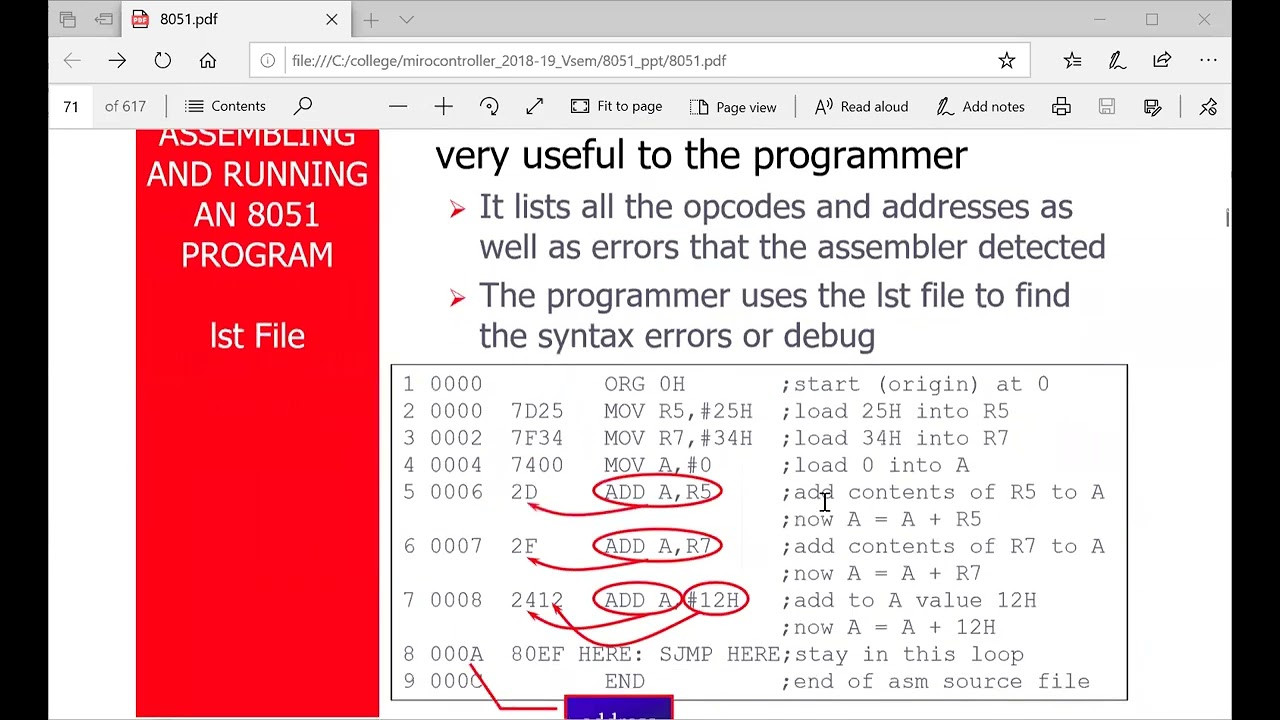
In this course you can be able understand the history and how a microcontroller is organized inside the internal structurer. The principle in the digital computing and the way of stored programmed concept. We will spend few hours on the basics of digital computing and will understand the hardware architecture of microcontroller 8051. The assembly language programming of 8051. The Programming on the 8051 resources along with the complier activity. We will learn to use the keil compilers and do the software simulation both in assembly and C. We will understand how to dump the hex file to the microcontroller. The detailed way of organizing and designing the memory map for 8051 will be studied with address map calculation. will design sample boards. Finally will design the 8051 based boards of Analog signal acquisition to microcontroller 8051 and delivering to a Digital to analog converter for Realtime signal functionality.
Read more
Similar classes
arrow icon previousarrow icon next
verified badge
Hello, I am a doctoral student in electrical engineering and associate professor in engineering sciences, experienced in the field of electrical engineering, I offer support courses in the subjects of engineering sciences (Electronics, automatics, electrical engineering, automation, programming).

Digital electronics
Analog electronic
electromagnetism (propagation of high frequency waves)
Automatic (continuous, sampled)
electrical engineering (transformers, electrical machines, switching power supply)
C / c ++ programming, Assembler, ARM, STM32
renewable energy (wind, PV)
engineering Sciences
RDM
Python,VHDL
PIC Microprocessor and Microcontroller
Signal processing and data acquisition
Engineering Sciences

These courses allow the student to get up to speed and regain confidence in all scientific subjects, just as they prepare him effectively for the Baccalaureate, the Preparatory Classes or various examinations of the engineering classes.

COURSE OBJECTIVES AND PEDAGOGICAL APPROACH

Resumption and deepening of fundamental concepts through exercises with course reminders.

Put the student in a situation of questioning and research.

Respond to individual issues and questions

Exercise training in order to achieve real mastery of the content.

Learn to build theoretical reasoning from observable facts or hypotheses.

Specific preparation for higher education requirements (in-depth content, increase in work capacity, enrichment of scientific background)

This educational approach is effective since it has often led me to interesting results with my students.

Associate professor provides support courses in electrical engineering
verified badge
Do you dream of mastering the art of electronic design, advanced programming and creating awesome robots? Do not look any further ! I offer personalized courses that will guide you into the exciting world of engineering, with an emphasis on electronics, programming and robotics.

Electronics: Learn to create circuits, understand components, and carry out innovative electronics projects.

Programming: Immerse yourself in the world of coding and develop programming skills, from classic languages to new technologies.

Robotics: Explore the basics of robotics, create autonomous robots, and discover how to bring your ideas to life.

Miscellaneous Projects: Use popular platforms like Arduino, Raspberry Pi, and more to bring your unique and exciting projects to life.

Whether you're a beginner or looking to deepen your skills, my classes are suitable for all levels. With interactive lessons, challenging projects, and expert guidance, you'll progress quickly and confidently.

Don't let your dreams of innovation wait any longer. Join me on this rewarding learning adventure and start creating today!
verified badge
✅ Experienced teacher offering private online physics lessons for all levels.
✅ Fully dedicated and focused on student progress.
✅ Very patient, systematic, and organized.

I teach a wide range of topics in physics, including but not limited to:

5- Physical quantities and units
- Kinematics (types of motion, kinematics of point particles and rigid bodies)
- Dynamics (frictional and inertial forces, Newton's laws)
- Laws of conservation (energy, momentum)
- Theory of collision processes
- Inertial and non-inertial reference frames
- Potential and kinetic energy
- Gravitation and gravity fields
- Oscillatory and wave motions
- Harmonic oscillator
- Doppler effect
- Standing waves
- Sound waves and physical characteristics of sound
- Surface tension and capillary phenomena
- Fluid mechanics
- Temperature and heat
- Calorimetry
- Phase transitions
- Principles of thermodynamics
- Electrostatics
- Electromagnetism
- Kirchhoff's laws
- Electronic circuits
- Dielectrics
- Optics
... and much more.

If there are specific topics you would like to focus on or if you have any questions, feel free to let me know. I am here to help you deepen your understanding of physics.
verified badge
Hello, I am a doctoral student in electrical engineering and associate professor in engineering sciences, experienced in the field of electrical engineering, I offer for students of preparatory classes and technical high school support courses in the subjects of engineering sciences (Electronics, automatic, electrical engineering, automation, programming).

Digital electronics
Analog electronic
electromagnetism
Automatic
electrical engineering (transformers, electrical machines, switching power supply)
C / c ++ programming, Assembler, ARM, STM32
renewable energy (wind, PV)
engineering Sciences
RDM
Python
PIC microcontroller
Microprocessor

These courses allow the student to get back to level and regain confidence in all scientific subjects, as well as effectively preparing him for the Baccalaureate, Preparatory Classes or various exams.

COURSE OBJECTIVES AND PEDAGOGICAL APPROACH

Resumption and deepening of fundamental concepts through exercises with course reminders.

Put the student in a situation of questioning and research.

Respond to individual issues and questions

Exercise training in order to achieve real mastery of the content.

Learn to build theoretical reasoning from observable facts or hypotheses.

Specific preparation for higher education requirements (in-depth content, increase in work capacity, enrichment of scientific background)

This educational approach is effective since it has often led me to interesting results with my students.

Associate professor provides support courses in electrical engineering
verified badge
Learn from the ground up, starting with the fundamentals of electronics and various electronic components.
Understand the necessary electrical connections to design and program smart home and Internet of Things (IoT) circuits.
Explore what Arduino is and the programming language used to control it.
Discover how to create programs to control home devices using a mobile phone.

Training includes working with real Arduino circuits as well as using simulation software.
I offer practical and simplified training that starts from the fundamentals of electronics and progresses to designing and programming smart home and Internet of Things (IoT) systems. The course includes clear theoretical explanations and hands-on applications using real circuits and digital simulation software.

Course Content

Electronics Fundamentals

Introduction to essential electronic components: resistors, capacitors, diodes, transistors, and sensors

Understanding proper electrical connections

Reading electronic circuits and using the breadboard

What is Arduino and How Do We Program It?

Introduction to Arduino boards

Explanation of the C/C++ programming language used for Arduino

How to upload code and test projects step by step

Designing and Programming Smart Home Circuits

Connecting sensors and smart switches

Controlling lighting and household devices

Designing a system to control the home using a mobile phone

Introduction to IoT and integrating it with home automation

Mobile Phone Home Control

Creating simple control interfaces

Connecting using Wi-Fi or Bluetooth

Turning devices on and off and monitoring sensors remotely

Practical Training

Working with real Arduino circuits

Using simulation software such as Tinkercad and Proteus

Building ready-to-use practical projects

Who Is This Course For?

Beginners in electronics

Students interested in learning Arduino programming

Anyone who wants to build a smart home project

Anyone looking to understand how electronics work in a simple and practical way
verified badge
I teach Electrical and Electronic Engineering online to university students, postgraduates, college students and serious self learners across the UK and Europe. Lessons are in English.

I hold an MSc in Electronics and Electrical Engineering with Distinction and I teach as a Visiting Lecturer on a Master's level module at a UK university. I also work as a freelance electronics engineer, designing circuit boards and writing firmware for real clients, and I have two accepted international conference papers. I set and mark university assignments myself, so I know where marks are won and lost on lab reports, coursework and project write ups.

Who this is for

Undergraduates on electrical, electronic, mechatronic or general engineering degrees at any European university. Final year, Master's and thesis students working on an engineering project. A Level, IB and college students taking physics or engineering. Career changers and self taught learners who want the fundamentals done properly rather than picked up from scattered videos.

I work with students on UK, IB and continental European programmes. An unfamiliar syllabus or a module structured differently from the UK is not a problem. Send me the material and I will work from it.

What we cover

Circuit analysis in DC and AC, including Kirchhoff's laws, Thevenin and Norton equivalents, superposition, phasors and AC power. Operational amplifiers and analogue electronics. Digital electronics and logic design. Signals and Systems and Digital Signal Processing, covering Fourier analysis, Laplace and z transforms, sampling and filter design. Control systems, transfer functions, root locus, Bode plots, stability and PID tuning. Semiconductor devices and power electronics. Embedded systems and microcontroller programming in C with Arduino, ESP32 and PIC. Simulation and tooling including MATLAB, Simulink, LTspice, Multisim and Proteus. Circuit board design in KiCAD. Lab reports, coursework, project supervision and exam technique.

How lessons work

Send me your lecture notes, assignment brief, lab sheet or the circuit that refuses to work, and I plan the session around it before we meet. Nothing generic.

Most students are stuck on one or two specific ideas rather than a whole module, so the first job is finding out which. Then we work through it with proper worked examples and real circuit diagrams, and I hand the problem back to you while I watch and correct, because you learn far more doing it than watching me do it.

If the real gap is the maths underneath a topic, complex numbers, phasors, Laplace transforms, we go back and fix that first, because everything after it depends on it.

You finish each session with annotated notes and a clear next step, and you can message me between lessons with questions.

Practical details

Lessons are online over Google Meet or Zoom, with screen sharing and a shared whiteboard so we can draw circuits and work through derivations together. Sessions run 60 or 90 minutes. Evenings and weekends available across European time zones.

Tell me your module, your deadline and exactly where you are stuck, and I will come back with a plan for the first session.
verified badge
Hello everyone and have a nice day,

As a teacher, teacher, student, teacher, professional teacher, and professional student/coaching/unterstützung in MATLAB/Simulink/embedded programme/automatic code generation...etc., you can also contact him.

Use this device for your Master Elektrotechnik-Ingenieur with a new academic design and installation tool in the basic model and use the Matlab/Simulink-Model for embedded System and Regelung on the E-Motoren with a fan and pass it. and Anforderungen.

For more information, please contact us. Unterstützung professionelle in Matlab, Simulink, C, Microcontroller and embedded Programmierung an.

There is a lot of expertise in this article, too:
- Matlab, Simulink,
- S-Functions, Simulink Modelle, Model Basierte Programmierung and Code Generation,
- Electrical drives and E-Motoren,
- STM32 Microcontroller,
- Rapid Prototyping mittels dSPACE HiL-Systeme and Echtzeit-Systeme,
- Power electronics / Leistungselektronik,
- Betreuung and Unterstützung während verschiedenenenenenen der projecterbeiten,
- ...

There is a lot of contact with you.

Very nice greetings
verified badge
Basics of electricity
electric current
electrical potential
The difference between power and electrical energy
Electrical resistance, its types, and methods of connection
How to calculate total resistance
How to calculate the total current in an electrical circuit and the current flowing through a branch
How to calculate the potential difference between two points
verified badge
HI, I’m Ali, an expert tutor in Electronics and Electrical Engineering with strong foundations in circuit design, simulation, and practical hardware systems.

Online lessons

If Electricity and Electronics make sense in class, but everything starts falling apart when the question becomes a real circuit, a phasor problem, an RLC response, or a simulation task, you are not alone.

Most students do not struggle because they are not capable.
They struggle because nobody has shown them how to think through the physical system properly, choose the right troubleshooting method, and present the solution with confidence.

That is exactly where I help.

WHAT MAKES MY TEACHING DIFFERENT
I do not teach Electrical Engineering, Electronics, and Circuit Theory as isolated topics.

I teach them as one connected system.

With my Electronics Engineering background and extensive hands-on experience in hardware systems design, my approach is always:

Model & Simulate

Solve & Optimise

Verify (Hardware/Software)

Improve & Troubleshoot

This means you do not just memorise formulas for one test. You learn how to approach unfamiliar engineering problems, schematic designs, and hardware constraints with structure, logic, and control.

WHO THIS PROFILE IS FOR
This profile is built for you if:

you understand parts of the topic, but struggle to connect theory to practical hardware implementation under pressure

you can follow solved textbook examples, but get stuck when starting circuit designs or simulations alone

your circuit setup, phasors, Laplace work, or PCB layouts break down mid-solution

you need technical help that is clear, structured, and highly relevant to your engineering modules or lab projects

you want a practical engineering method, not vague motivation

you want to become independent, mastering industry-standard tools instead of relying on memorised steps

WHAT YOU WILL ACTUALLY IMPROVE
I focus on the parts of Electronics and Electrical Engineering that usually decide whether a student feels in control, or completely stuck.

That includes improving how you handle:

Electrical Circuits, Mesh/Nodal Circuit Analysis, AC and DC Circuits

Phasors, complex impedance, and RLC Circuits

Circuit Simulations (Proteus, LTspice, Multisim, KiCad, Altium Designer)

Hardware Design, PCB Layout, and routing constraints

Analogue and Digital Electronics, Electronic Devices, and VLSI/SoC concepts

Signals & Systems, Signal Processing, and Control Systems block diagrams

Digital Logic Design (DLD), Boolean Algebra, K-Maps, and State Machines (FSM)

Embedded Systems, microcontrollers, and integrating Machine Learning into hardware

Applied Mathematics for Engineers, Calculus, Differential Equations, Fourier Analysis, and Laplace Transforms

WHAT I HELP STUDENTS DO
Most students come to me because they want more than a basic theoretical explanation.

They want to be able to:

read the engineering question or schematic properly

identify what the circuit or system is actually doing

choose the correct analysis method faster

set up the software simulations cleanly and debug errors

avoid common hardware and design mistakes

finish with a working layout or solution they can justify

SUBJECT AREAS I SUPPORT
My main subject support is built around:

Electronics Engineering

Circuit Design & Simulation

Electrical Engineering Foundations

Digital Logic Design

Within that, I regularly position lessons around high-value areas such as:

Circuit Analysis (AC/DC) & Phasors

PCB Layout & Hardware Prototyping

Embedded Systems & Microcontrollers

Control Systems & Signal Processing

Digital Logic Design & Digital Systems

Solid State Devices & VLSI Concepts

For students on broader technical pathways (like Mechatronics, Robotics, or Automation), I can also support connected areas like programming, sensor integration, and machine learning applications when they are part of your course demands.

HOW MY ENGINEERING BACKGROUND HELPS
My Electronics Engineering background, combined with practical industry exposure in testing labs, grid stations, and professional freelance PCB design, is useful here for one reason:

it pushes disciplined, real-world technical thinking.

Instead of rushing to formulas, I train students to understand the circuit model and software verification first. That changes everything.

It helps you see:

what the components and systems are actually doing

why one simulation tool or design choice fits better than another

where errors and noise usually enter the solution

how to verify the hardware design before moving to fabrication

That is the difference between copying worked examples and actually understanding engineering.

HOW THE SUPPORT FEELS
Students usually work well with me because the sessions are:

structured, calm, and technical

practical and focused on real design improvement

You do not get vague advice. You get direction, software walkthroughs, and a debugging method you can keep using after the lesson ends. This is especially useful for students preparing for exams, difficult university modules, lab tasks, or Final Year Projects (FYPs).

WHY THIS APPROACH WORKS
A lot of students spend hours watching tutorials, but still cannot design a circuit or solve questions independently. Passive exposure is not the same as technical control.

My goal is to make you someone who can start the question or design with confidence, move through the layout or working without panicking, and build stronger engineering performance over time.

BEFORE WE START, FIT CHECK
To make the first lesson useful from the start, send:

Level / Degree Course

Exam board or university module guidelines

Exam date, project deadline, or timeline

3 priority topics or software tools you want to master

The exact point where you get stuck

1 to 3 questions, project briefs, or screenshots
verified badge
This hands-on training pathway is designed to help students kickstart any project, specifically tailored for OT labs and industrial applications. Starting from absolute scratch, students will build a strong foundation in Python programming through practical, industry-relevant concepts.

Curriculum Outline: |
01 - Python Environment Setup & Basics |
02 - Python Variables, Numbers, Bytes & Hex |
03 - Control Flow Logic Functions |
04 - Data Structures (Lists, Tuples, Dictionaries & Sets) |
05 - String Formatting, Comprehensions & Exception Handling |
06 - File IO, Pathlib & Context Managers |
07 - Object-Oriented Programming (Classes & OOP) |
08 - Standard Library, Modules & Networking Basics |

Assessment & Evaluation:
Students will take a mini-test after the completion of each module. Additionally, an Audit & Performance Evaluation report will be sent following the tests.
Duration:
5 days to 15 days (depending on the pace of the cohort)
verified badge
Electricity Teacher - Live Lessons from a Real Classroom

TIRED OF CLASSES IN FRONT OF A BLANK SHEET OF PAPER?

I give my lessons LIVE from a classroom with a blackboard and chalk.
Like at school, but with Google Meet at home.

FOR WHO ?
MIDDLE SCHOOL / HIGH SCHOOL: Circuits, laws, safety, reading diagrams
Vocational Baccalaureate: Power diagram, control diagram, wiring, installation
BTS: Industrial diagrams, motor starting, relays and contactors

MY METHOD:
We're working on YOUR exercises. I'll explain them to you step by step on the board.
Clear and concrete explanations with examples from construction sites.
You see everything I write and you leave with photos from the course.

HOW DOES IT WORK?
100% online course via Google Meet.
Professional quality: Sound + Image + Visible painting.
Opening hours: Evenings and weekends, French time.

Levels: Beginner to Advanced. First lesson to try it out.
verified badge
Electrical engineering is a current trend and upcoming future necessity for people day to day life. so I will teach about how our electrical engineering help our day to day life and it remain use full and safe to our environment and people . People of this world must know about safety measures of electrical system. Also I will teach how to protect our environment and nature by using electrical engineering concept. The above content what I mentioned is learned by future students and taught by me.
verified badge
Physics is a fascinating subject that helps us understand how the world around us works. As an experienced scientist with a passion for teaching and sharing science, I enjoy helping students develop a deeper and more intuitive understanding of physics. My lessons cover topics including classical mechanics, optics, electromagnetism, quantum mechanics, and quantum optics, and can be tailored to your level and learning goals. Whether you are preparing for an exam, studying at university, or simply curious about physics, I focus on clear explanations, problem-solving, and making even challenging concepts easier to understand.
verified badge
Electronic, communication systems,electromagnetic fields , embedded system, digital electronic, digital signal processing, digital image processing,optical communication, signals and systems,applied electronics, microwave engineering,TLN,radio engineering
verified badge
In this 30-minute class, we will understand the two core components of a microprocessor: the ALU (Arithmetic Logic Unit) and the Control Unit. I will explain their structure, functions, and how they work together to execute instructions, using simple diagrams and practical examples. The goal is to build a clear understanding of how a microprocessor processes and controls data.
Video thumbnail
Play icon
Karlmarx's video
message icon
Contact Karlmarx
repeat students icon
1st lesson is backed
by our
Good-fit Instructor Guarantee
Similar classes
arrow icon previousarrow icon next
verified badge
Hello, I am a doctoral student in electrical engineering and associate professor in engineering sciences, experienced in the field of electrical engineering, I offer support courses in the subjects of engineering sciences (Electronics, automatics, electrical engineering, automation, programming).

Digital electronics
Analog electronic
electromagnetism (propagation of high frequency waves)
Automatic (continuous, sampled)
electrical engineering (transformers, electrical machines, switching power supply)
C / c ++ programming, Assembler, ARM, STM32
renewable energy (wind, PV)
engineering Sciences
RDM
Python,VHDL
PIC Microprocessor and Microcontroller
Signal processing and data acquisition
Engineering Sciences

These courses allow the student to get up to speed and regain confidence in all scientific subjects, just as they prepare him effectively for the Baccalaureate, the Preparatory Classes or various examinations of the engineering classes.

COURSE OBJECTIVES AND PEDAGOGICAL APPROACH

Resumption and deepening of fundamental concepts through exercises with course reminders.

Put the student in a situation of questioning and research.

Respond to individual issues and questions

Exercise training in order to achieve real mastery of the content.

Learn to build theoretical reasoning from observable facts or hypotheses.

Specific preparation for higher education requirements (in-depth content, increase in work capacity, enrichment of scientific background)

This educational approach is effective since it has often led me to interesting results with my students.

Associate professor provides support courses in electrical engineering
verified badge
Do you dream of mastering the art of electronic design, advanced programming and creating awesome robots? Do not look any further ! I offer personalized courses that will guide you into the exciting world of engineering, with an emphasis on electronics, programming and robotics.

Electronics: Learn to create circuits, understand components, and carry out innovative electronics projects.

Programming: Immerse yourself in the world of coding and develop programming skills, from classic languages to new technologies.

Robotics: Explore the basics of robotics, create autonomous robots, and discover how to bring your ideas to life.

Miscellaneous Projects: Use popular platforms like Arduino, Raspberry Pi, and more to bring your unique and exciting projects to life.

Whether you're a beginner or looking to deepen your skills, my classes are suitable for all levels. With interactive lessons, challenging projects, and expert guidance, you'll progress quickly and confidently.

Don't let your dreams of innovation wait any longer. Join me on this rewarding learning adventure and start creating today!
verified badge
✅ Experienced teacher offering private online physics lessons for all levels.
✅ Fully dedicated and focused on student progress.
✅ Very patient, systematic, and organized.

I teach a wide range of topics in physics, including but not limited to:

5- Physical quantities and units
- Kinematics (types of motion, kinematics of point particles and rigid bodies)
- Dynamics (frictional and inertial forces, Newton's laws)
- Laws of conservation (energy, momentum)
- Theory of collision processes
- Inertial and non-inertial reference frames
- Potential and kinetic energy
- Gravitation and gravity fields
- Oscillatory and wave motions
- Harmonic oscillator
- Doppler effect
- Standing waves
- Sound waves and physical characteristics of sound
- Surface tension and capillary phenomena
- Fluid mechanics
- Temperature and heat
- Calorimetry
- Phase transitions
- Principles of thermodynamics
- Electrostatics
- Electromagnetism
- Kirchhoff's laws
- Electronic circuits
- Dielectrics
- Optics
... and much more.

If there are specific topics you would like to focus on or if you have any questions, feel free to let me know. I am here to help you deepen your understanding of physics.
verified badge
Hello, I am a doctoral student in electrical engineering and associate professor in engineering sciences, experienced in the field of electrical engineering, I offer for students of preparatory classes and technical high school support courses in the subjects of engineering sciences (Electronics, automatic, electrical engineering, automation, programming).

Digital electronics
Analog electronic
electromagnetism
Automatic
electrical engineering (transformers, electrical machines, switching power supply)
C / c ++ programming, Assembler, ARM, STM32
renewable energy (wind, PV)
engineering Sciences
RDM
Python
PIC microcontroller
Microprocessor

These courses allow the student to get back to level and regain confidence in all scientific subjects, as well as effectively preparing him for the Baccalaureate, Preparatory Classes or various exams.

COURSE OBJECTIVES AND PEDAGOGICAL APPROACH

Resumption and deepening of fundamental concepts through exercises with course reminders.

Put the student in a situation of questioning and research.

Respond to individual issues and questions

Exercise training in order to achieve real mastery of the content.

Learn to build theoretical reasoning from observable facts or hypotheses.

Specific preparation for higher education requirements (in-depth content, increase in work capacity, enrichment of scientific background)

This educational approach is effective since it has often led me to interesting results with my students.

Associate professor provides support courses in electrical engineering
verified badge
Learn from the ground up, starting with the fundamentals of electronics and various electronic components.
Understand the necessary electrical connections to design and program smart home and Internet of Things (IoT) circuits.
Explore what Arduino is and the programming language used to control it.
Discover how to create programs to control home devices using a mobile phone.

Training includes working with real Arduino circuits as well as using simulation software.
I offer practical and simplified training that starts from the fundamentals of electronics and progresses to designing and programming smart home and Internet of Things (IoT) systems. The course includes clear theoretical explanations and hands-on applications using real circuits and digital simulation software.

Course Content

Electronics Fundamentals

Introduction to essential electronic components: resistors, capacitors, diodes, transistors, and sensors

Understanding proper electrical connections

Reading electronic circuits and using the breadboard

What is Arduino and How Do We Program It?

Introduction to Arduino boards

Explanation of the C/C++ programming language used for Arduino

How to upload code and test projects step by step

Designing and Programming Smart Home Circuits

Connecting sensors and smart switches

Controlling lighting and household devices

Designing a system to control the home using a mobile phone

Introduction to IoT and integrating it with home automation

Mobile Phone Home Control

Creating simple control interfaces

Connecting using Wi-Fi or Bluetooth

Turning devices on and off and monitoring sensors remotely

Practical Training

Working with real Arduino circuits

Using simulation software such as Tinkercad and Proteus

Building ready-to-use practical projects

Who Is This Course For?

Beginners in electronics

Students interested in learning Arduino programming

Anyone who wants to build a smart home project

Anyone looking to understand how electronics work in a simple and practical way
verified badge
I teach Electrical and Electronic Engineering online to university students, postgraduates, college students and serious self learners across the UK and Europe. Lessons are in English.

I hold an MSc in Electronics and Electrical Engineering with Distinction and I teach as a Visiting Lecturer on a Master's level module at a UK university. I also work as a freelance electronics engineer, designing circuit boards and writing firmware for real clients, and I have two accepted international conference papers. I set and mark university assignments myself, so I know where marks are won and lost on lab reports, coursework and project write ups.

Who this is for

Undergraduates on electrical, electronic, mechatronic or general engineering degrees at any European university. Final year, Master's and thesis students working on an engineering project. A Level, IB and college students taking physics or engineering. Career changers and self taught learners who want the fundamentals done properly rather than picked up from scattered videos.

I work with students on UK, IB and continental European programmes. An unfamiliar syllabus or a module structured differently from the UK is not a problem. Send me the material and I will work from it.

What we cover

Circuit analysis in DC and AC, including Kirchhoff's laws, Thevenin and Norton equivalents, superposition, phasors and AC power. Operational amplifiers and analogue electronics. Digital electronics and logic design. Signals and Systems and Digital Signal Processing, covering Fourier analysis, Laplace and z transforms, sampling and filter design. Control systems, transfer functions, root locus, Bode plots, stability and PID tuning. Semiconductor devices and power electronics. Embedded systems and microcontroller programming in C with Arduino, ESP32 and PIC. Simulation and tooling including MATLAB, Simulink, LTspice, Multisim and Proteus. Circuit board design in KiCAD. Lab reports, coursework, project supervision and exam technique.

How lessons work

Send me your lecture notes, assignment brief, lab sheet or the circuit that refuses to work, and I plan the session around it before we meet. Nothing generic.

Most students are stuck on one or two specific ideas rather than a whole module, so the first job is finding out which. Then we work through it with proper worked examples and real circuit diagrams, and I hand the problem back to you while I watch and correct, because you learn far more doing it than watching me do it.

If the real gap is the maths underneath a topic, complex numbers, phasors, Laplace transforms, we go back and fix that first, because everything after it depends on it.

You finish each session with annotated notes and a clear next step, and you can message me between lessons with questions.

Practical details

Lessons are online over Google Meet or Zoom, with screen sharing and a shared whiteboard so we can draw circuits and work through derivations together. Sessions run 60 or 90 minutes. Evenings and weekends available across European time zones.

Tell me your module, your deadline and exactly where you are stuck, and I will come back with a plan for the first session.
verified badge
Hello everyone and have a nice day,

As a teacher, teacher, student, teacher, professional teacher, and professional student/coaching/unterstützung in MATLAB/Simulink/embedded programme/automatic code generation...etc., you can also contact him.

Use this device for your Master Elektrotechnik-Ingenieur with a new academic design and installation tool in the basic model and use the Matlab/Simulink-Model for embedded System and Regelung on the E-Motoren with a fan and pass it. and Anforderungen.

For more information, please contact us. Unterstützung professionelle in Matlab, Simulink, C, Microcontroller and embedded Programmierung an.

There is a lot of expertise in this article, too:
- Matlab, Simulink,
- S-Functions, Simulink Modelle, Model Basierte Programmierung and Code Generation,
- Electrical drives and E-Motoren,
- STM32 Microcontroller,
- Rapid Prototyping mittels dSPACE HiL-Systeme and Echtzeit-Systeme,
- Power electronics / Leistungselektronik,
- Betreuung and Unterstützung während verschiedenenenenenen der projecterbeiten,
- ...

There is a lot of contact with you.

Very nice greetings
verified badge
Basics of electricity
electric current
electrical potential
The difference between power and electrical energy
Electrical resistance, its types, and methods of connection
How to calculate total resistance
How to calculate the total current in an electrical circuit and the current flowing through a branch
How to calculate the potential difference between two points
verified badge
HI, I’m Ali, an expert tutor in Electronics and Electrical Engineering with strong foundations in circuit design, simulation, and practical hardware systems.

Online lessons

If Electricity and Electronics make sense in class, but everything starts falling apart when the question becomes a real circuit, a phasor problem, an RLC response, or a simulation task, you are not alone.

Most students do not struggle because they are not capable.
They struggle because nobody has shown them how to think through the physical system properly, choose the right troubleshooting method, and present the solution with confidence.

That is exactly where I help.

WHAT MAKES MY TEACHING DIFFERENT
I do not teach Electrical Engineering, Electronics, and Circuit Theory as isolated topics.

I teach them as one connected system.

With my Electronics Engineering background and extensive hands-on experience in hardware systems design, my approach is always:

Model & Simulate

Solve & Optimise

Verify (Hardware/Software)

Improve & Troubleshoot

This means you do not just memorise formulas for one test. You learn how to approach unfamiliar engineering problems, schematic designs, and hardware constraints with structure, logic, and control.

WHO THIS PROFILE IS FOR
This profile is built for you if:

you understand parts of the topic, but struggle to connect theory to practical hardware implementation under pressure

you can follow solved textbook examples, but get stuck when starting circuit designs or simulations alone

your circuit setup, phasors, Laplace work, or PCB layouts break down mid-solution

you need technical help that is clear, structured, and highly relevant to your engineering modules or lab projects

you want a practical engineering method, not vague motivation

you want to become independent, mastering industry-standard tools instead of relying on memorised steps

WHAT YOU WILL ACTUALLY IMPROVE
I focus on the parts of Electronics and Electrical Engineering that usually decide whether a student feels in control, or completely stuck.

That includes improving how you handle:

Electrical Circuits, Mesh/Nodal Circuit Analysis, AC and DC Circuits

Phasors, complex impedance, and RLC Circuits

Circuit Simulations (Proteus, LTspice, Multisim, KiCad, Altium Designer)

Hardware Design, PCB Layout, and routing constraints

Analogue and Digital Electronics, Electronic Devices, and VLSI/SoC concepts

Signals & Systems, Signal Processing, and Control Systems block diagrams

Digital Logic Design (DLD), Boolean Algebra, K-Maps, and State Machines (FSM)

Embedded Systems, microcontrollers, and integrating Machine Learning into hardware

Applied Mathematics for Engineers, Calculus, Differential Equations, Fourier Analysis, and Laplace Transforms

WHAT I HELP STUDENTS DO
Most students come to me because they want more than a basic theoretical explanation.

They want to be able to:

read the engineering question or schematic properly

identify what the circuit or system is actually doing

choose the correct analysis method faster

set up the software simulations cleanly and debug errors

avoid common hardware and design mistakes

finish with a working layout or solution they can justify

SUBJECT AREAS I SUPPORT
My main subject support is built around:

Electronics Engineering

Circuit Design & Simulation

Electrical Engineering Foundations

Digital Logic Design

Within that, I regularly position lessons around high-value areas such as:

Circuit Analysis (AC/DC) & Phasors

PCB Layout & Hardware Prototyping

Embedded Systems & Microcontrollers

Control Systems & Signal Processing

Digital Logic Design & Digital Systems

Solid State Devices & VLSI Concepts

For students on broader technical pathways (like Mechatronics, Robotics, or Automation), I can also support connected areas like programming, sensor integration, and machine learning applications when they are part of your course demands.

HOW MY ENGINEERING BACKGROUND HELPS
My Electronics Engineering background, combined with practical industry exposure in testing labs, grid stations, and professional freelance PCB design, is useful here for one reason:

it pushes disciplined, real-world technical thinking.

Instead of rushing to formulas, I train students to understand the circuit model and software verification first. That changes everything.

It helps you see:

what the components and systems are actually doing

why one simulation tool or design choice fits better than another

where errors and noise usually enter the solution

how to verify the hardware design before moving to fabrication

That is the difference between copying worked examples and actually understanding engineering.

HOW THE SUPPORT FEELS
Students usually work well with me because the sessions are:

structured, calm, and technical

practical and focused on real design improvement

You do not get vague advice. You get direction, software walkthroughs, and a debugging method you can keep using after the lesson ends. This is especially useful for students preparing for exams, difficult university modules, lab tasks, or Final Year Projects (FYPs).

WHY THIS APPROACH WORKS
A lot of students spend hours watching tutorials, but still cannot design a circuit or solve questions independently. Passive exposure is not the same as technical control.

My goal is to make you someone who can start the question or design with confidence, move through the layout or working without panicking, and build stronger engineering performance over time.

BEFORE WE START, FIT CHECK
To make the first lesson useful from the start, send:

Level / Degree Course

Exam board or university module guidelines

Exam date, project deadline, or timeline

3 priority topics or software tools you want to master

The exact point where you get stuck

1 to 3 questions, project briefs, or screenshots
verified badge
This hands-on training pathway is designed to help students kickstart any project, specifically tailored for OT labs and industrial applications. Starting from absolute scratch, students will build a strong foundation in Python programming through practical, industry-relevant concepts.

Curriculum Outline: |
01 - Python Environment Setup & Basics |
02 - Python Variables, Numbers, Bytes & Hex |
03 - Control Flow Logic Functions |
04 - Data Structures (Lists, Tuples, Dictionaries & Sets) |
05 - String Formatting, Comprehensions & Exception Handling |
06 - File IO, Pathlib & Context Managers |
07 - Object-Oriented Programming (Classes & OOP) |
08 - Standard Library, Modules & Networking Basics |

Assessment & Evaluation:
Students will take a mini-test after the completion of each module. Additionally, an Audit & Performance Evaluation report will be sent following the tests.
Duration:
5 days to 15 days (depending on the pace of the cohort)
verified badge
Electricity Teacher - Live Lessons from a Real Classroom

TIRED OF CLASSES IN FRONT OF A BLANK SHEET OF PAPER?

I give my lessons LIVE from a classroom with a blackboard and chalk.
Like at school, but with Google Meet at home.

FOR WHO ?
MIDDLE SCHOOL / HIGH SCHOOL: Circuits, laws, safety, reading diagrams
Vocational Baccalaureate: Power diagram, control diagram, wiring, installation
BTS: Industrial diagrams, motor starting, relays and contactors

MY METHOD:
We're working on YOUR exercises. I'll explain them to you step by step on the board.
Clear and concrete explanations with examples from construction sites.
You see everything I write and you leave with photos from the course.

HOW DOES IT WORK?
100% online course via Google Meet.
Professional quality: Sound + Image + Visible painting.
Opening hours: Evenings and weekends, French time.

Levels: Beginner to Advanced. First lesson to try it out.
verified badge
Electrical engineering is a current trend and upcoming future necessity for people day to day life. so I will teach about how our electrical engineering help our day to day life and it remain use full and safe to our environment and people . People of this world must know about safety measures of electrical system. Also I will teach how to protect our environment and nature by using electrical engineering concept. The above content what I mentioned is learned by future students and taught by me.
verified badge
Physics is a fascinating subject that helps us understand how the world around us works. As an experienced scientist with a passion for teaching and sharing science, I enjoy helping students develop a deeper and more intuitive understanding of physics. My lessons cover topics including classical mechanics, optics, electromagnetism, quantum mechanics, and quantum optics, and can be tailored to your level and learning goals. Whether you are preparing for an exam, studying at university, or simply curious about physics, I focus on clear explanations, problem-solving, and making even challenging concepts easier to understand.
verified badge
Electronic, communication systems,electromagnetic fields , embedded system, digital electronic, digital signal processing, digital image processing,optical communication, signals and systems,applied electronics, microwave engineering,TLN,radio engineering
verified badge
In this 30-minute class, we will understand the two core components of a microprocessor: the ALU (Arithmetic Logic Unit) and the Control Unit. I will explain their structure, functions, and how they work together to execute instructions, using simple diagrams and practical examples. The goal is to build a clear understanding of how a microprocessor processes and controls data.
Good-fit Instructor Guarantee
favorite button
message icon
Contact Karlmarx