


Trusted teacher
This teacher has a fast response time and rate, demonstrating a high quality of service to their students.

Since March 2026
Instructor since March 2026
Translated by Google
With a doctorate in Sports Science,

From 94 C$ /h

Accustomed to teaching in very different contexts (University, companies, associations, individuals), I adapt my teaching to the specific profile of the learner, taking into account their wishes (type of practice) and objectives (performance, health, etc.), their physical characteristics and abilities (height, weight) and their state of health (age, functional limitations), and finally, their motivation (workload they are ready to assume in class and in personal work).
As a rigorous and dedicated teacher, I believe that if a student isn't progressing sufficiently, it's because the teaching approach isn't suitable. Therefore, it's essential to create a learning environment that is serious, inspiring, engaging, and so on, depending on the needs of each student. The diverse environments and student populations I've taught have taught me this. And then there's the matter of providing resources as needed: whether it's theoretical texts or customized educational videos, the modern world offers us an endless array of tools!
Regarding tai chi, you probably know that there are several styles, which will be used in different ways depending on one's objectives.
The Yang style is particularly recommended when practicing primarily for health reasons: the rhythm is uniformly slow, allowing for complete control over movement, calm and safe weight transfer, and improved balance while developing proprioception.
The Chen style, on the other hand, is characterized by a more staccato rhythm. It is more explosive, as it relies more heavily on the body's momentum and the re-engagement of external forces (gravity, ground reaction, friction, tension/release). It is better suited when performance is the goal, particularly in combat.
Whatever your goals and needs, we will work on your relationship with strength. Strength is essential, of course, in any physical activity: building strength is, in fact, the first step in traditional learning, the one for children; the next two, which lead to lasting expertise—the kind that reconciles performance and health requirements—are more difficult to achieve without proper guidance, and that's where I see my added value. It's beyond strength that I can offer: the optimal use of this precious resource (gaining efficiency by improving its ability to transmit kinetic energy), and the mobilization of other, more subtle, less obvious, but equally concrete external forces (gravity, ground reaction force, friction, tension/release, elastic force, etc.). This is what justifies all the work on body awareness (and proprioception) so central to traditional martial arts.
Know that even if the commitment on your part and mine is serious, like martial arts, nothing prevents us from having fun: I also promise you joy, good humor, and lightness, because it is in my nature.
As a rigorous and dedicated teacher, I believe that if a student isn't progressing sufficiently, it's because the teaching approach isn't suitable. Therefore, it's essential to create a learning environment that is serious, inspiring, engaging, and so on, depending on the needs of each student. The diverse environments and student populations I've taught have taught me this. And then there's the matter of providing resources as needed: whether it's theoretical texts or customized educational videos, the modern world offers us an endless array of tools!
Regarding tai chi, you probably know that there are several styles, which will be used in different ways depending on one's objectives.
The Yang style is particularly recommended when practicing primarily for health reasons: the rhythm is uniformly slow, allowing for complete control over movement, calm and safe weight transfer, and improved balance while developing proprioception.
The Chen style, on the other hand, is characterized by a more staccato rhythm. It is more explosive, as it relies more heavily on the body's momentum and the re-engagement of external forces (gravity, ground reaction, friction, tension/release). It is better suited when performance is the goal, particularly in combat.
Whatever your goals and needs, we will work on your relationship with strength. Strength is essential, of course, in any physical activity: building strength is, in fact, the first step in traditional learning, the one for children; the next two, which lead to lasting expertise—the kind that reconciles performance and health requirements—are more difficult to achieve without proper guidance, and that's where I see my added value. It's beyond strength that I can offer: the optimal use of this precious resource (gaining efficiency by improving its ability to transmit kinetic energy), and the mobilization of other, more subtle, less obvious, but equally concrete external forces (gravity, ground reaction force, friction, tension/release, elastic force, etc.). This is what justifies all the work on body awareness (and proprioception) so central to traditional martial arts.
Know that even if the commitment on your part and mine is serious, like martial arts, nothing prevents us from having fun: I also promise you joy, good humor, and lightness, because it is in my nature.
Location


At student's location :
- Around Issy-les-Moulineaux, France
At teacher's location :
- Avenue Pasteur, Montreuil, France

Online from France
About Me
My journey in practice:
Having been passionate about sports since my earliest childhood, it was only as I approached adulthood that I switched to the world of martial arts.
First with Thai boxing, within the Lamson circle of the Japy gymnasium (Paris 11): 6 years which introduced me to the extreme rigors of striking combat.
Aware that the continuation of my progress in the art of combat required a radical change of method, I then turned to traditional practices and the Wan Laisheng association, where Master Liang (Chaoqun) and his most promising young student, Alexandre T., officiated. I trained with them for 7-8 years, a period punctuated by two two-month stays in a training camp in Zhanjiang (China): Shaolin Liuhe Men, Ziran Men, Yang style Taiji Quan, then Xingyi Quan, Bagua Zhang formed the basis of my conversion.
Without relaxing my commitment to these disciplines, I wanted to enrich my understanding of the technical and pedagogical issues specific to Chinese martial arts, and spent two years in Taiwan as much to learn Mandarin as to continue my martial odyssey.
My training then continued with masters Xu (Xianlong) and Lin (Zhihao), his disciple, two renowned experts who were also great teachers: Xu Xianlong writes the teaching manuals for teachers of Chinese martial arts in Taiwan.
Better informed about these issues, and initiated into a new style, so different, the fanzi quan or style of reversal/unbalancing, I rejoined the Wan Laisheng association in Paris, before returning a few years later to Japan where I followed for two years the teaching of yawara, an ancient form of jujitsu, by Iwaki sensei (Iwaki Shosui), and that of chen style taiji quan by Yamasaki sensei (Yamasaki Hiroshi).
These recent learnings have particularly marked me, with Yamasaki sensei's theorizing abilities playing a significant role, making me aware of the importance of eliminating force as a step and condition for developing the ability to exploit kinetic energy, jing, and external forces (gravity, ground reaction, elastic force, etc.), the ultimate springs of sustainable performance because it is non-deleterious.
My theoretical training in service of transmission:
On a more theoretical level, I was initially trained in the philosophy of the body (Master's degree Paris I/EHESS); then, after my stays in China, my interest in martial practices led me to spend two years in Taiwan learning Chinese (National Taiwan Normal University) before reorienting myself to STAPS (Master's degree) to then dedicate a doctoral research to them ('Body techniques in the light of Chinese martial arts: the process of naturalizing technique', directed by B. During and B. Andrieu, 2017).
After a first postdoctoral fellowship in Japan (JSPS/Kyoto University, 2019-2021) where I was able to investigate other practices, not only martial (yawara, chen style taiji, sento), and a second for the IRBA (2021-2022) during which I worked on the transfer of the pedagogical expertise of traditional martial arts to the benefit of military healthcare workers, I joined the University of Paris Cité and the Institute of Sport and Health Sciences in 2022 as a teacher-researcher.
Having been passionate about sports since my earliest childhood, it was only as I approached adulthood that I switched to the world of martial arts.
First with Thai boxing, within the Lamson circle of the Japy gymnasium (Paris 11): 6 years which introduced me to the extreme rigors of striking combat.
Aware that the continuation of my progress in the art of combat required a radical change of method, I then turned to traditional practices and the Wan Laisheng association, where Master Liang (Chaoqun) and his most promising young student, Alexandre T., officiated. I trained with them for 7-8 years, a period punctuated by two two-month stays in a training camp in Zhanjiang (China): Shaolin Liuhe Men, Ziran Men, Yang style Taiji Quan, then Xingyi Quan, Bagua Zhang formed the basis of my conversion.
Without relaxing my commitment to these disciplines, I wanted to enrich my understanding of the technical and pedagogical issues specific to Chinese martial arts, and spent two years in Taiwan as much to learn Mandarin as to continue my martial odyssey.
My training then continued with masters Xu (Xianlong) and Lin (Zhihao), his disciple, two renowned experts who were also great teachers: Xu Xianlong writes the teaching manuals for teachers of Chinese martial arts in Taiwan.
Better informed about these issues, and initiated into a new style, so different, the fanzi quan or style of reversal/unbalancing, I rejoined the Wan Laisheng association in Paris, before returning a few years later to Japan where I followed for two years the teaching of yawara, an ancient form of jujitsu, by Iwaki sensei (Iwaki Shosui), and that of chen style taiji quan by Yamasaki sensei (Yamasaki Hiroshi).
These recent learnings have particularly marked me, with Yamasaki sensei's theorizing abilities playing a significant role, making me aware of the importance of eliminating force as a step and condition for developing the ability to exploit kinetic energy, jing, and external forces (gravity, ground reaction, elastic force, etc.), the ultimate springs of sustainable performance because it is non-deleterious.
My theoretical training in service of transmission:
On a more theoretical level, I was initially trained in the philosophy of the body (Master's degree Paris I/EHESS); then, after my stays in China, my interest in martial practices led me to spend two years in Taiwan learning Chinese (National Taiwan Normal University) before reorienting myself to STAPS (Master's degree) to then dedicate a doctoral research to them ('Body techniques in the light of Chinese martial arts: the process of naturalizing technique', directed by B. During and B. Andrieu, 2017).
After a first postdoctoral fellowship in Japan (JSPS/Kyoto University, 2019-2021) where I was able to investigate other practices, not only martial (yawara, chen style taiji, sento), and a second for the IRBA (2021-2022) during which I worked on the transfer of the pedagogical expertise of traditional martial arts to the benefit of military healthcare workers, I joined the University of Paris Cité and the Institute of Sport and Health Sciences in 2022 as a teacher-researcher.
Education
Doctorate in Sport Sciences, Motor Skills and Human Movement (SSMMH), doctoral thesis entitled: "Body techniques in the light of Chinese martial arts: the process of naturalizing technique"
Master's degree in the History of Ancient Philosophy (Paris I); Master's degree in Social Sciences (EHESS); Master's degree in STAPS (Paris 5)
Bachelor's degree in Philosophy (Paris I)
Hypokhâgne, khâgne classique (Lycée Fénelon)
Baccalaureate in Literature (Lycée Louis Le Grand)
Master's degree in the History of Ancient Philosophy (Paris I); Master's degree in Social Sciences (EHESS); Master's degree in STAPS (Paris 5)
Bachelor's degree in Philosophy (Paris I)
Hypokhâgne, khâgne classique (Lycée Fénelon)
Baccalaureate in Literature (Lycée Louis Le Grand)
Experience / Qualifications
4 years of university teaching; 15 years of teaching in an associative context, in France and abroad (Taiwan, Japan)
Age
Children (7-12 years old)
Teenagers (13-17 years old)
Adults (18-64 years old)
Seniors (65+ years old)
Student level
Beginner
Intermediate
Advanced
Duration
60 minutes
90 minutes
120 minutes
The class is taught in
French
English
Chinese
Skills

Availability of a typical week
(GMT -04:00)
New York

At teacher's location and via webcam

At student's home
Mon
Tue
Wed
Thu
Fri
Sat
Sun
00-04
04-08
08-12
12-16
16-20
20-24
Accustomed to teaching in very different contexts (University, companies, associations, individuals), I adapt my teaching to the specific profile of the learner, taking into account their wishes (type of practice) and objectives (performance, health, etc.), their physical characteristics and abilities (height, weight) and their state of health (age, functional limitations), and finally, their motivation (workload they are ready to assume in class and in personal work).
As a rigorous and dedicated teacher, I believe that if a student isn't progressing sufficiently, it's because the teaching approach isn't suitable. Therefore, it's essential to create a learning environment that is serious, inspiring, engaging, and so on, depending on the needs of each student. The diverse environments and student populations I've taught have taught me this. And then there's the matter of providing resources as needed: whether it's theoretical texts or customized educational videos, the modern world offers us an endless array of tools!
For beginners, it's essential to start by establishing a technical foundation and preparing the body for the physical demands of the sport (classic strength, speed, and flexibility training, along with cardio to support it all!). For this initial level, I draw on both Muay Thai, my original training, and Kung Fu, which serves this purpose very well. The introduction to striking combat initially focuses on maximizing distance (reach); we'll gradually close the distance as reaction time and the psychological readiness required for combat develop.
For intermediate and advanced levels, I prefer to focus on the "natural style" (see video). This is what will allow you to break through the glass ceiling. It's demanding, certainly, but you'll gain considerable speed (through fluidity) and impact (through the optimal use of kinetic energy and external forces); you'll also be calmer and more composed in combat; your strategy will evolve, you'll become a counter-puncher, a sniper. Everything will progress, but you'll have to do a large part of the work on your own, my role being limited to guiding your practice by introducing you to the exercises and acting as your sparring partner, to identify the next areas for improvement.
All of this seems very cold and serious, and it is, because combat transforms you profoundly. However, nothing prevents you from enjoying it: I also promise you joy, good humor, and lightheartedness, because that's in my nature.
As a rigorous and dedicated teacher, I believe that if a student isn't progressing sufficiently, it's because the teaching approach isn't suitable. Therefore, it's essential to create a learning environment that is serious, inspiring, engaging, and so on, depending on the needs of each student. The diverse environments and student populations I've taught have taught me this. And then there's the matter of providing resources as needed: whether it's theoretical texts or customized educational videos, the modern world offers us an endless array of tools!
For beginners, it's essential to start by establishing a technical foundation and preparing the body for the physical demands of the sport (classic strength, speed, and flexibility training, along with cardio to support it all!). For this initial level, I draw on both Muay Thai, my original training, and Kung Fu, which serves this purpose very well. The introduction to striking combat initially focuses on maximizing distance (reach); we'll gradually close the distance as reaction time and the psychological readiness required for combat develop.
For intermediate and advanced levels, I prefer to focus on the "natural style" (see video). This is what will allow you to break through the glass ceiling. It's demanding, certainly, but you'll gain considerable speed (through fluidity) and impact (through the optimal use of kinetic energy and external forces); you'll also be calmer and more composed in combat; your strategy will evolve, you'll become a counter-puncher, a sniper. Everything will progress, but you'll have to do a large part of the work on your own, my role being limited to guiding your practice by introducing you to the exercises and acting as your sparring partner, to identify the next areas for improvement.
All of this seems very cold and serious, and it is, because combat transforms you profoundly. However, nothing prevents you from enjoying it: I also promise you joy, good humor, and lightheartedness, because that's in my nature.
Accustomed to teaching in very different contexts (University, companies, associations, individuals), I adapt my teaching to the specific profile of the learner, taking into account their wishes (type of practice) and objectives (performance, health, etc.), their physical characteristics and abilities (height, weight) and their state of health (age, functional limitations), and finally, their motivation (workload they are ready to assume in class and in personal work).
As a rigorous and dedicated teacher, I believe that if a student isn't progressing sufficiently, it's because the teaching approach isn't suitable. Therefore, it's essential to create a learning environment that is serious, inspiring, engaging, and so on, depending on the needs of each student. The diverse environments and student populations I've taught have taught me this. And then there's the matter of providing resources as needed: whether it's theoretical texts or customized educational videos, the modern world offers us an endless array of tools!
As for kung fu itself, it is particularly well-suited for growing children because it helps to structure the body, which is very beneficial from an anatomical and biomechanical standpoint, especially given the body's rapid development. Furthermore, its forms (taolu, or martial arts choreography) greatly develop coordination, balance, dexterity, spatial awareness, and other transferable skills applicable to a wide range of activities, thus contributing significantly to the psychomotor development of children, adolescents, and young adults. This does not exclude older individuals, but their psychomotor development is more mature, while that of younger people is still developing; therefore, kung fu is highly structured.
Another important benefit is cultivating one's relationship with strength. Strength is obviously necessary in any physical activity: building strength is, in fact, the first step in traditional training. One discovers how to mobilize this resource, generate it in different parts of the body, and transfer it to the target. Then, gradually, one arrives at more refined expressions and uses, more respectful of the logic of the human body. In Chinese terms, it's about moving from li (brute force resulting from the voluntary use of muscles) to jing (kinetic energy, derived from movement, whatever its origin, which one learns to channel).
All of this seems very cold and serious, and it is, because kung fu transforms you profoundly. However, nothing prevents you from having fun: I also promise you joy, good humor, and lightheartedness, because that's in my nature.
As a rigorous and dedicated teacher, I believe that if a student isn't progressing sufficiently, it's because the teaching approach isn't suitable. Therefore, it's essential to create a learning environment that is serious, inspiring, engaging, and so on, depending on the needs of each student. The diverse environments and student populations I've taught have taught me this. And then there's the matter of providing resources as needed: whether it's theoretical texts or customized educational videos, the modern world offers us an endless array of tools!
As for kung fu itself, it is particularly well-suited for growing children because it helps to structure the body, which is very beneficial from an anatomical and biomechanical standpoint, especially given the body's rapid development. Furthermore, its forms (taolu, or martial arts choreography) greatly develop coordination, balance, dexterity, spatial awareness, and other transferable skills applicable to a wide range of activities, thus contributing significantly to the psychomotor development of children, adolescents, and young adults. This does not exclude older individuals, but their psychomotor development is more mature, while that of younger people is still developing; therefore, kung fu is highly structured.
Another important benefit is cultivating one's relationship with strength. Strength is obviously necessary in any physical activity: building strength is, in fact, the first step in traditional training. One discovers how to mobilize this resource, generate it in different parts of the body, and transfer it to the target. Then, gradually, one arrives at more refined expressions and uses, more respectful of the logic of the human body. In Chinese terms, it's about moving from li (brute force resulting from the voluntary use of muscles) to jing (kinetic energy, derived from movement, whatever its origin, which one learns to channel).
All of this seems very cold and serious, and it is, because kung fu transforms you profoundly. However, nothing prevents you from having fun: I also promise you joy, good humor, and lightheartedness, because that's in my nature.
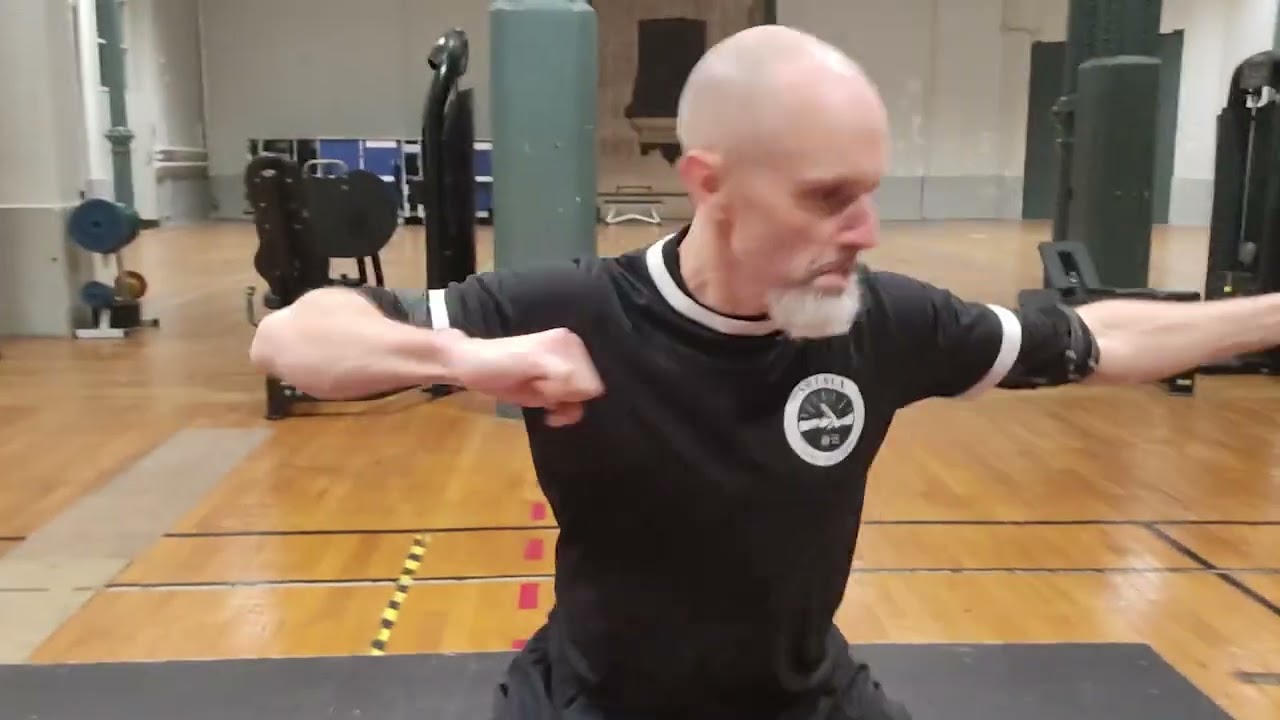

Alexandre's video

Contact Alexandre

1st lesson is backed
by our Good-fit Instructor Guarantee
by our Good-fit Instructor Guarantee
Good-fit Instructor Guarantee
Contact Alexandre